
CGPA: What It Means, How to Calculate It, and How to Recover When It's Low
A practical guide grounded in real numbers, not motivation posters
CGPA meaning
CGPA stands for Cumulative Grade Point Average. It's the average of all the grade points you've earned across every semester, weighted by credit hours.
Your semester GPA tells you how one term went. Your CGPA tells you where you actually stand after everything.
Most universities in Pakistan, India, and many other countries use a 4.0 scale. Some use 5.0. The number itself doesn't matter as much as understanding what scale your institution uses and where your score sits on it.
A quick reference on the 4.0 scale:
• 3.5 to 4.0: strong academic standing
• 3.0 to 3.4: solid, competitive in most fields
• 2.5 to 2.9: acceptable, but some doors start closing
• Below 2.5: causes real difficulty for graduate programs and selective employers
One thing worth knowing: CGPA is a cumulative number. Early semesters carry permanent weight. A 2.1 in your first year doesn't disappear. It gets diluted over time, but never erased. This is why students who recover from a rough start often need two or three strong semesters just to move the number by 0.2 or 0.3.
What your CGPA tells about you
A CGPA number, by itself, is a limited signal. It tells you how consistently you performed inside a structured system over time.
That's genuinely useful information. Employers who care about CGPA are mostly screening for reliability and follow-through, not intelligence. Can this person show up, do the work, and perform consistently across different subjects and different pressures? CGPA answers that question with a single number.
What it doesn't tell anyone:
• Whether you took hard courses or easy ones
• Whether your university has grade inflation
• Whether you built any real skills
• Whether you're curious, resourceful, or good under ambiguous conditions
A 3.8 CGPA from a school known for grade inflation and a 3.2 from a rigorous engineering program are not the same thing. Graduate admissions committees and experienced recruiters know this. They look at the institution, the major, and the transcript pattern, not just the final number.
So yes, CGPA matters. It's a real filter in real hiring processes. But it's one data point, not a verdict.
How to calculate your CGPA
The calculation is straightforward once you see it in steps.
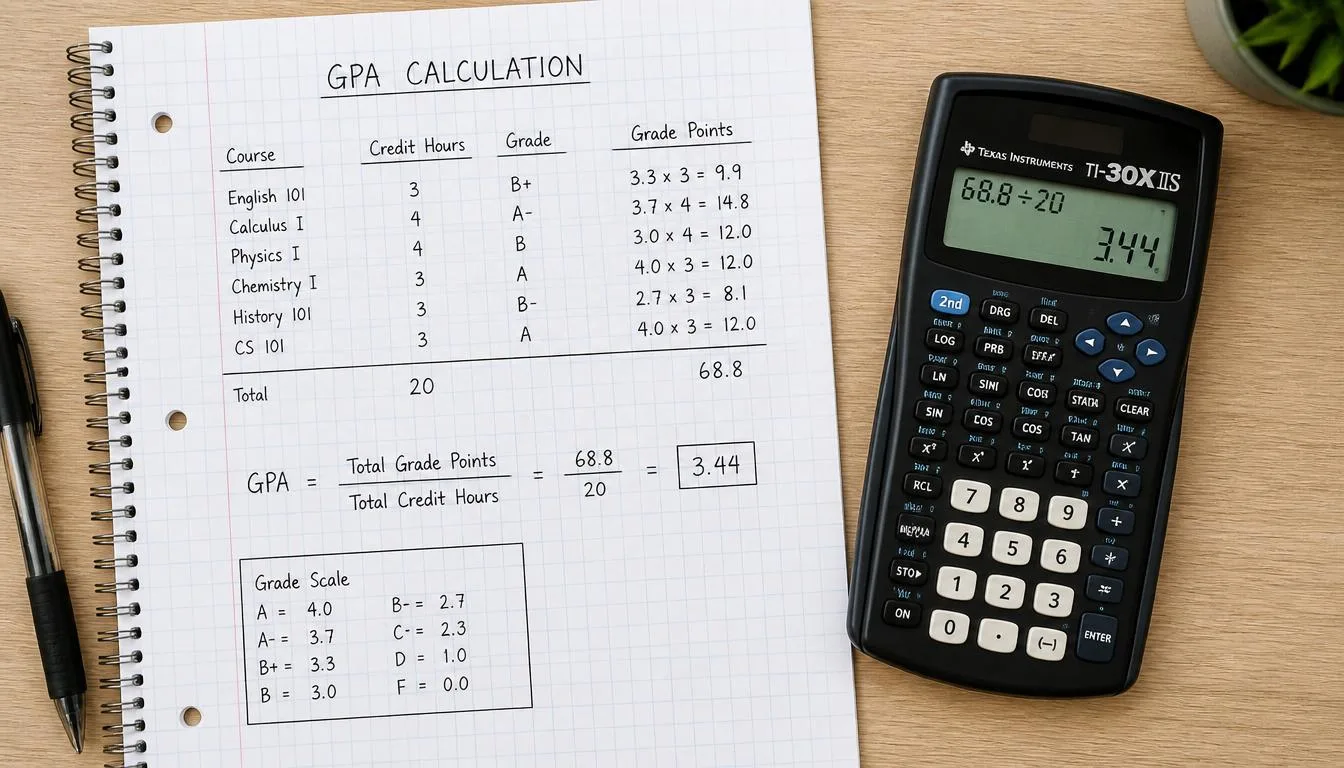
Every course has two things: a grade (converted to grade points) and a credit hour value. You multiply those together to get quality points. Add up all the quality points, divide by total credit hours attempted, and you have your CGPA.
Grade point conversion (4.0 scale)
• A / A+ = 4.0
• A- = 3.7
• B+ = 3.3
• B = 3.0
• B- = 2.7
• C+ = 2.3
• C = 2.0
• D = 1.0
• F = 0.0
Example calculation
Say you completed two semesters with these results:
Semester 1 (10 total credit hours):
• Math (3 credits): A = 4.0 → 12 quality points
• English (3 credits): B = 3.0 → 9 quality points
• History (4 credits): C = 2.0 → 8 quality points
• Total: 29 quality points ÷ 10 credits = 2.9 GPA
Semester 2 (9 total credit hours):
• Physics (3 credits): B+ = 3.3 → 9.9 quality points
• Economics (3 credits): A = 4.0 → 12 quality points
• Statistics (3 credits): B = 3.0 → 9 quality points
• Total: 30.9 quality points ÷ 9 credits = 3.43 GPA
Cumulative CGPA: (29 + 30.9) ÷ (10 + 9) = 59.9 ÷ 19 = 3.15
Notice: Semester 2 was stronger, but the CGPA only moved to 3.15, not close to 3.43. That's the weight of earlier performance pulling the cumulative number down. This is why early grades matter more than students expect.
To raise CGPA efficiently, take higher-credit courses when you're performing well. A strong grade in a 4-credit course moves the number faster than the same grade in a 1-credit elective.
Surviving with a low CGPA: how to improve it
A low CGPA is a real problem in some contexts and a non-issue in others. The honest answer depends on what you're aiming for.
For graduate school applications, a CGPA below 3.0 requires a strong compensating factor: a high GRE/GMAT score, published research, or professional experience in the field. Below 2.5, most competitive programs will filter you out before a human reader sees your file.
For entry-level jobs in finance, consulting, or engineering, many large firms apply a 3.0 or 3.5 screening cutoff in automated systems. If your CGPA falls below that threshold, your application may not reach a recruiter.
For everything else, a low CGPA matters less than people think, especially once you have 2 to 3 years of work experience.
What actually moves a low CGPA
1. Retake courses with grade replacement. Many universities allow grade replacement: the new grade replaces the old one in CGPA calculations. A C replaced by an A in a 3-credit course produces a meaningful shift. Check your institution's exact policy before registering. Some schools average both grades instead of replacing.
2. Load up on high-credit courses when you're ready. CGPA is a weighted average. A strong performance in a 4-credit course does more than four 1-credit electives. If you're in a position to perform well, take the heavier courses.
3. Stop taking P/F courses as a defensive habit. Pass/fail courses don't hurt your CGPA, but they don't help it either. If you're trying to raise your number, you need graded courses where you earn A's. P/F protects a fragile CGPA; it doesn't improve one.
4. Be honest about the semester load. Overloading while behind is how CGPAs collapse further. Five difficult courses in one semester, all performed poorly, each carrying credit hours, is a recovery-killer. A lighter load with strong grades is better math.
5. Address the actual reason for low performance. CGPA doesn't drop randomly. It drops because something specific went wrong: poor time management, wrong major, personal difficulties, weak foundational knowledge in prerequisite subjects. Fixing the number requires identifying the cause, not just trying harder.
What helps when CGPA stays low
Some CGPAs won't recover in time for graduation. That's a real situation, not a failure of character.
Two internships with strong references from supervisors carry more weight in most hiring conversations than a CGPA improvement from 2.6 to 2.9. A portfolio of real work, a professional certification, or a demonstrable skill in a specific tool often opens doors that a CGPA cutoff closed.
Graduate school with a low CGPA is still possible through post-baccalaureate programs, bridge courses, or professional master's programs with less competitive admissions. Some students take a gap year, build a professional record, and apply with that context framing their academic history.
A low CGPA limits specific paths. It doesn't close everything.
FAQs
Does CGPA reset each year?
No. CGPA is cumulative. It carries every grade from every semester you've completed. Your semester GPA resets, but the cumulative number incorporates all previous performance.
Can a single failing grade ruin your CGPA?
It can cause serious damage, especially early in your degree. An F gives 0 quality points but still counts in your total credit hours attempted. That means you carry the weight of the course without earning any return. Failing and retaking a course twice does compounding damage unless your school has grade replacement.
Is a 3.0 CGPA good?
It depends on the field, the institution, and what you're applying for. A 3.0 keeps most professional doors open. It won't get you filtered out of most entry-level applications. For highly competitive graduate programs or selective employers with explicit cutoffs, 3.0 is the floor, not a competitive position.
Do graduate schools look at semester GPA or CGPA?
Both. CGPA is the headline number. But admissions committees also look at transcript trends. A student with a 2.8 CGPA who scored 3.7 across their last two semesters tells a different story than a student with a 2.8 that has been flat for four years.
How many semesters does it take to raise CGPA by 0.3?
It depends on how many credit hours you've already completed. Earlier in your degree, CGPA moves faster because you have fewer total hours weighting the average. With 60 credit hours already on record, raising CGPA by 0.3 points typically requires 2 to 3 semesters of consistently strong performance. With 120 credit hours, the same improvement takes longer.
Does CGPA matter for jobs outside academia?
For the first 2 to 3 years after graduation, yes, in selective industries. After that, your professional record is what employers evaluate. Nobody asks a 30-year-old project manager for their undergraduate CGPA.
Personal opinion
CGPA is worth taking seriously. It isn't worth organizing your entire student life around.
The students who end up in the strongest positions five years after graduation aren't the ones who had the highest CGPAs. They're the ones who built real skills, worked on things that mattered, and figured out how to be useful to people around them.
CGPA functions as a floor. Getting above 3.0 keeps doors open. Getting above 3.5 helps in competitive situations. Pushing from 3.5 to 3.9 by refusing internships, skipping interesting projects, and avoiding hard courses is, in most cases, a bad trade.
There's also something worth saying about what CGPA actually measures: consistency inside a structured system. You show up, learn what's expected, and produce it reliably. That's a real skill. Employers who care about it are often testing for that, not raw intelligence.
What CGPA doesn't measure is curiosity, judgment under pressure, the ability to work with difficult people, or how you behave when the structure disappears. Those things matter more the further you go.
Keep your CGPA reasonable. Don't let it collapse. Then spend the remaining energy on things that make you genuinely good at something.
A 3.3 with two internships and a real project is a stronger candidate in most fields than a 3.9 with nothing else to show.