
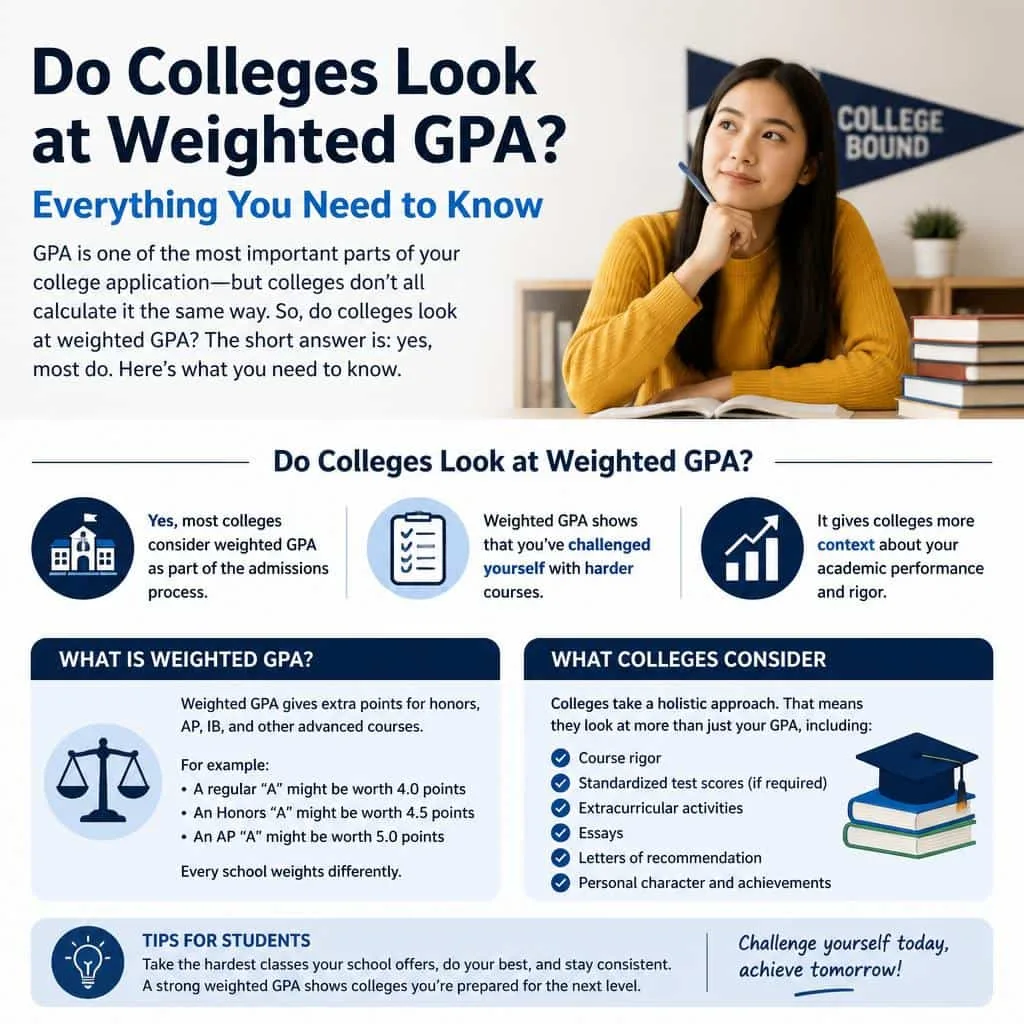
Do Colleges Look at Weighted GPA? Everything You Need to Know
A complete guide to weighted GPA, how it differs from unweighted GPA, and why it matters for your future.
If you have ever stared at your report card wondering whether colleges actually care about your weighted GPA or your unweighted one, you are not alone. It is one of the most common, and most confusing, questions students and parents ask every single year.
The short answer? Yes, colleges look at weighted GPA. But the full answer is a lot more interesting than that.
This guide breaks everything down, what weighted GPA is, how it compares to unweighted GPA, how to calculate it step by step, and what it actually means for your college admissions and career. No fluff, no fake statistics. Just real, useful information.
What Is Weighted GPA?
A weighted GPA is a grade point average that gives extra value to harder courses. If you take Advanced Placement (AP), International Baccalaureate (IB), or Honors classes, those courses are assigned a higher point value than regular classes.
On a standard weighted scale, a typical A in a regular class earns 4.0 points. But an A in an AP class earns 5.0 points. The same grade, but a higher reward for the tougher workload.
This system exists for a reason. Without it, a student taking all standard-level classes could have the same GPA as a student juggling five AP courses. That would not be a fair comparison, and colleges know it.
According to the College Board, over 1.3 million students took AP exams in 2023. These students are actively seeking to demonstrate academic rigor, and weighted GPA is one way that effort shows up on paper.
Weighted GPAs can go above 4.0. In fact, a 4.5 or even a 5.0 weighted GPA is entirely possible and fairly common among high-achieving students.
What Is the Difference Between Weighted and Unweighted GPA?
This is where students often get confused. Let us make it simple.
|
Feature |
Unweighted GPA |
Weighted GPA |
|
Max Scale |
4.0 |
5.0 (or higher) |
|
Counts Course Difficulty |
No |
Yes |
|
AP/IB Bonus Points |
None |
0.5 – 1.0 extra points |
|
Used By Colleges? |
Yes |
Yes (often recalculated) |
|
Better Shows Rigor? |
No |
Yes |
The unweighted GPA treats every class equally. An A is a 4.0 whether you earned it in gym class or AP Calculus. The weighted GPA says, "Hold on, not all classes are created equal."
Neither one is bad. But weighted GPA gives a fuller picture of what a student is actually capable of, and willing to challenge themselves with.
Do Colleges Look at Weighted GPA?
Yes, but with an important caveat. Most colleges look at both. They consider your weighted GPA to understand how hard you pushed yourself, and your unweighted GPA to get a clean, consistent benchmark.
Here is the thing many students do not realize: many colleges recalculate your GPA on their own scale. Harvard, MIT, and most large research universities strip out the weight and recompute your GPA using their internal system. So your 4.7 weighted GPA might show up as a 3.9 in their database.
That sounds unfair, but it is actually a way to compare students from different schools fairly. Not every high school uses the same weighting system.
According to NACAC (National Association for College Admission Counseling), grades in college preparatory courses are consistently ranked as one of the most important factors in admissions decisions. Course rigor, which is reflected in your weighted GPA, sits right alongside.
So what does this mean for you? Take challenging classes. Do well in them. Both your GPA numbers will benefit.
A 3.8 unweighted GPA with rigorous coursework will almost always impress more than a 4.0 unweighted GPA earned entirely in standard-level classes. Admissions officers are humans (yes, really), and they read your transcript carefully.
How to Calculate Weighted GPA: A Step-by-Step Guide
Calculating your weighted GPA is not complicated once you know the logic. Here is a clear, step-by-step breakdown.

Step 1 — Assign Point Values to Your Grades
Use this standard weighted scale:
• A = 5.0 (AP/IB/Honors) | 4.0 (Regular)
• B = 4.0 (AP/IB/Honors) | 3.0 (Regular)
• C = 3.0 (AP/IB/Honors) | 2.0 (Regular)
• D = 2.0 (AP/IB/Honors) | 1.0 (Regular)
Step 2 — List All Your Courses and Grades
Write down every course from your transcript along with the grade you earned and the course type (AP, Honors, or Regular).
Step 3 — Convert Each Grade to Its Weighted Value
Using the scale above, convert each grade to its weighted point value. For example, a B in AP English becomes a 4.0, while a B in regular Math becomes a 3.0.
Step 4 — Add All the Points Together
Sum up the weighted point values for all your courses.
Step 5 — Divide by the Number of Courses
Divide the total points by the total number of classes. That result is your weighted GPA.
Example Calculation
Let us say a student has the following courses in one semester:
• AP Biology — A → 5.0 points
• Honors English — B → 4.0 points
• Regular History — A → 4.0 points
• Regular Spanish — B → 3.0 points
• AP Calculus — B → 4.0 points
Total points: 5.0 + 4.0 + 4.0 + 3.0 + 4.0 = 20.0
Weighted GPA: 20.0 ÷ 5 = 4.0. Simple as that.
The Impact of Weighted GPA on Your Career
Your weighted GPA matters most during the college admissions process, but its ripple effect stretches further than that.
A strong weighted GPA can open doors to scholarships. Many merit-based scholarships use GPA thresholds, and a weighted GPA above 4.0 often qualifies students for more opportunities. According to Sallie Mae's 2023 report, scholarships covered about 26% of college costs for families, so this is not a small thing.
Getting into a stronger college because of your GPA also has long-term career implications. Research from Georgetown University's Center on Education and the Workforce consistently shows that graduates from more selective institutions tend to have higher lifetime earnings, on average.
Beyond admissions, a high school GPA, weighted or unweighted, rarely appears on a resume after your first job. But the discipline, work ethic, and critical thinking skills you develop by challenging yourself with hard courses? Those carry with you everywhere.
In short: your weighted GPA is a short-term key that opens long-term doors. It is not everything, but it is definitely something.
A Personal Opinion on Weighted GPA
Here is a perspective worth considering. The obsession with GPA, weighted or otherwise, can go too far.
Too many students load up on AP classes not because they love the subject, but because they want the GPA boost. The result? Burnout, anxiety, and a transcript full of subjects they never actually engaged with.
Challenge yourself. yes, absolutely. But do it strategically. Pick AP or Honors courses in subjects you genuinely care about or plan to study further. A 4.2 weighted GPA with authentic curiosity beats a 4.7 earned through four years of pure stress.
Admissions officers are not robots reading numbers. They want to see a real student, a real story, and a real trajectory. Your weighted GPA is one piece of that story, make sure the rest of your application tells it well.
Frequently Asked Questions (FAQs)
Q: Do all colleges look at weighted GPA?
Not exactly. Most colleges look at both your weighted and unweighted GPA, and many will recalculate your GPA using their own internal formula. What matters most is your course rigor and your grades within that context.
Q: Is a 4.5 weighted GPA good?
Yes. A 4.5 weighted GPA is above average and signals strong performance in challenging classes. For highly selective schools, it is competitive, but remember that your application as a whole, essays, activities, recommendations, also matters significantly.
Q: Can weighted GPA hurt you in college admissions?
It is very rare, but overloading on hard courses and earning poor grades can hurt you. A C in an AP class is better than a C in a regular class on the weighted scale, but it still raises flags. Quality matters more than quantity when it comes to course selection.
Q: Does weighted GPA affect scholarships?
Yes, many scholarships use GPA as a qualifying factor, and they often accept weighted GPA. Always check each scholarship's specific requirements, as some specify unweighted GPA only.
Q: What is a good weighted GPA for Ivy League schools?
Most admitted students at Ivy League institutions have weighted GPAs above 4.0, with averages often sitting between 4.1 and 4.5. However, Ivy League admissions consider far more than GPA, extracurriculars, essays, and recommendations play equally important roles.
Final Thoughts
Weighted GPA is a useful tool, for you and for colleges. It rewards effort, reflects course rigor, and gives admissions officers a more complete picture of your academic capabilities.
Understanding the difference between weighted and unweighted GPA, knowing how colleges use them, and learning how to calculate your own GPA puts you ahead of most students. And that is exactly what this guide was here to help you do.
So go back to that report card, look at those numbers, and remember: a number does not define you. But understanding what it means, and working strategically toward your goals, absolutely can.