

GPA Explained
What It Is, How It Works, and Why It Actually Matters
You have probably heard the term GPA thrown around since high school. Professors mention it. Parents ask about it. Job postings sometimes list a minimum requirement for it. But a lot of students go through years of school without really understanding what their GPA tells them, how it gets calculated, or when it stops mattering.
This article covers all of it, plainly and honestly.
What Is GPA?
GPA stands for Grade Point Average. It is a single number that represents your academic performance across all the courses you have taken. Instead of showing a list of 30 individual grades, a transcript condenses everything into one score.
Most schools in the United States use a 4.0GPA scale. On that scale, an A equals 4.0GPA, a B equals 3.0, a C equals 2.0, a D equals 1.0, and an F equals 0. Some schools go further and add plus and minus grades. An A minus becomes 3.7GPA, a B plus becomes 3.3GPA, and so on.
There are two versions of GPA you will encounter throughout school.
Your semester GPA covers only the courses you took in a single term. It resets every semester. A bad semester raises your GPA if it was worse before, or lowers it if you were doing well. Either way, it only reflects that one period.
Your cumulative GPA is the one that matters most. It covers every course across every semester you have completed. When someone asks for your GPA, this is almost always what they want. It is what appears on your transcript, what graduate schools evaluate, and what employers sometimes screen.
How GPA Works
The mechanics are straightforward once you see them laid out.
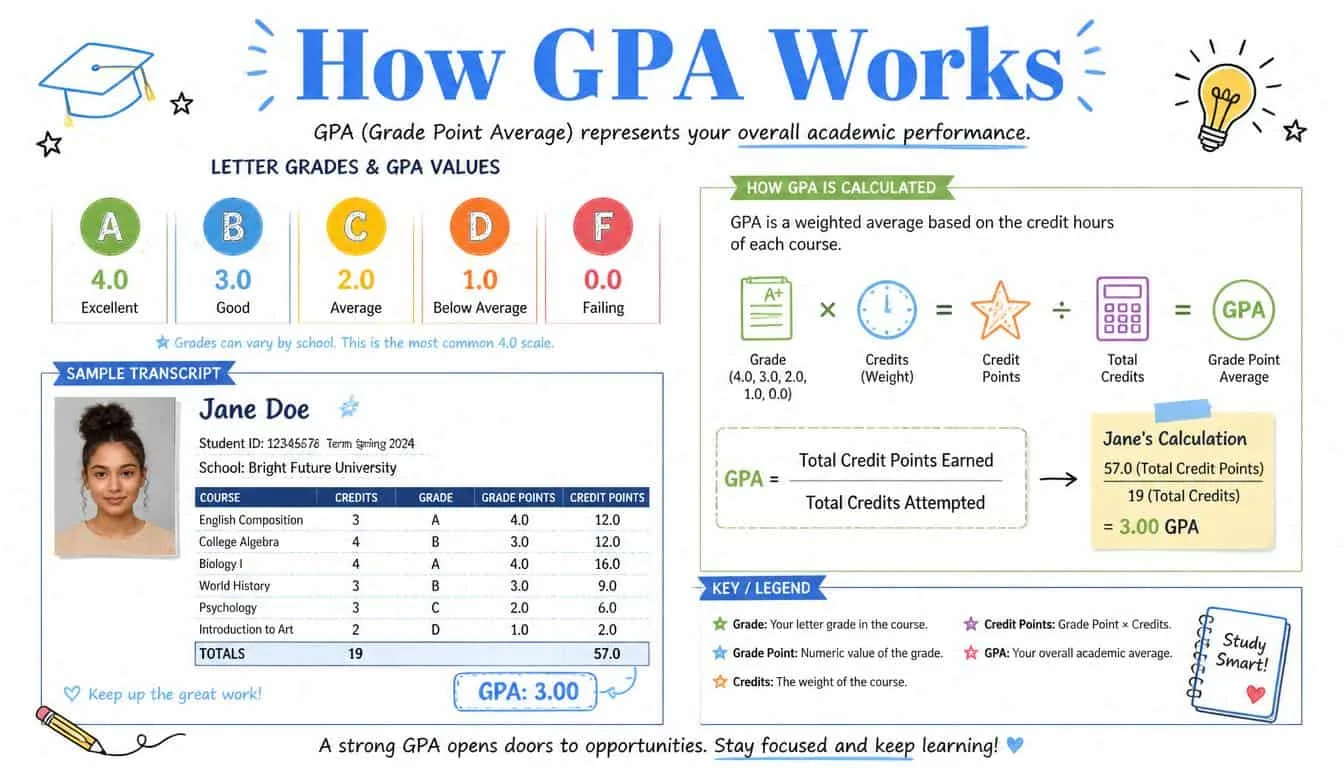
Every course you take has two things attached to it: a grade and a credit hour value. Credit hours reflect how much time the course demands. A standard lecture course is usually 3 credit hours. A lab or heavier course might be 4. A seminar might be 1 or 2.
Your GPA is not a simple average of your grades. It is a weighted average, where heavier courses pull more weight than lighter ones. That means a 4-credit course affects your GPA more than a 3-credit course, and both affect it more than a 1-credit elective.
To calculate GPA, (check out at https://acadtools.online/blog?page=1&tag=all# ) each course's grade gets converted to grade points, then multiplied by the credit hours for that course. The result is called quality points. You add up all the quality points from every course, then divide by the total number of credit hours you have attempted.
One thing students often miss: failing a course does not just hurt your GPA by giving you a 0GPA. It also stays in your total credit hours attempted unless your school allows grade replacement. So you carry the weight of a 0 without earning any credit toward graduation. That is why failing and retaking a course twice does more damage than most people expect.
How to Calculate Your GPA
Here is a concrete example. Suppose you take three courses in a semester:
• Math (3 credit hours) — you earn an A, which is 4.0GPA grade points
• English (3 credit hours) — you earn a B, which is 3.0GPA grade points
• History (4 credit hours) — you earn a C, which is 2.0GPA grade points
Step one: multiply each grade by its credit hours.
• Math: 4.0 × 3 = 12 quality points
• English: 3.0 × 3 = 9 quality points
• History: 2.0 × 4 = 8 quality points
Step two: add the quality points. 12 + 9 + 8 = 29 total quality points.
Step three: add the credit hours. 3 + 3 + 4 = 10 total credit hours.
Step four: divide. 29 ÷ 10 = 2.9 GPA.
Notice that History pulled the GPA down more than the other courses because it had 4 credits. If History had been a 3-credit course, the GPA would have come out higher. That is the weighting at work.
For your cumulative GPA, you do the same calculation but across every course you have ever taken. Most schools calculate this automatically and show it on your transcript. But knowing how it works helps you think strategically. If you want to raise your GPA, focus on higher-credit courses because they move the number faster.
Impacts of GPA on Your Career
Graduate school admissions. GPA matters a lot for graduate school. Programs in medicine, law, business, and engineering treat it as one of the first filters. Most law schools and medical schools want a 3.5 or above just to be taken seriously. MBA programs at competitive schools look for 3.4GPA to 3.7GPA depending on the school. Going below 3.0GPA in most fields means you will need something unusually strong elsewhere, like a high test score or years of relevant experience, to overcome it.
Entry-level jobs out of college. For your first 2 to 3 years after graduation, GPA still gets used, especially in corporate recruiting. Investment banks, management consulting firms, and large engineering companies often apply a 3.5GPA cutoff when screening applications. If your application goes through an automated filter, a GPA below that threshold might mean it never reaches a human reader. That said, this is heavily industry-dependent. Creative fields, startups, trades, and most small businesses pay little attention to GPA.
After a few years of work experience. Once you have 3GPA or more years of real work history, GPA becomes largely irrelevant. Your projects, results, and professional reputation take over. Nobody asks a 35-year-old project manager for their undergraduate GPA. The window where it matters most is roughly from graduation to your late 20s.
Scholarships and academic honors. Schools and external organizations tie scholarships directly to GPA. Maintaining a 3.0 is often required just to keep a merit scholarship. Academic honors at graduation, including cum laude (typically 3.5), magna cum laude (3.7), and summa cum laude (3.9), are determined by GPA thresholds that vary by school.
Federal and government employment. Certain federal hiring programs use GPA as an eligibility requirement. The Outstanding Scholar program, for example, requires a 3.5GPA or higher and allows agencies to hire directly without a competitive exam. If government work is a goal, your GPA has a concrete and specific impact.
FAQs
Does every school use a 4.0 scale? No. Some US schools use a 5.0 scale to allow more room for weighted grades. International schools often use entirely different systems. UK universities use degree classifications like First, Second Upper, and Second Lower rather than a GPA. German universities use a 1.0 to 5.0GPA scale where 1.0GPA is the best score, the opposite of what American students expect. If you are applying internationally, be aware the scales differ.
Can retaking a course fix your GPA? It depends on your school. Many schools use a grade replacement policy where the new grade replaces the old one in GPA calculations, though the original grade may still appear on the transcript. Some schools average both grades. Before retaking a course specifically to fix your GPA, check exactly how your school handles it. Retaking a course you passed with a C to get an A is usually worth it.
What is actually a good GPA? It depends entirely on context. A 3.2GPA in chemical engineering at a rigorous school is a stronger signal than a 3.9 in a less demanding program. A 3.5 is widely considered strong. A 3.0 to 3.4 is fine for most purposes. Below 3.0GPA starts to raise questions in competitive fields. Below 2.5 causes real difficulty for graduate school and some professional programs.
Do Pass/Fail courses affect GPA? Usually not. Most schools exclude P/F grades from GPA calculations entirely. This is why students sometimes take a risky course pass/fail to protect their GPA. The tradeoff is that the course also will not help your GPA if you do well. Some programs restrict how many P/F credits you can apply toward your degree, so check before you register.
Does the school you attend affect how GPA is perceived? Yes, meaningfully. A 3.5GPA from a highly selective school and a 3.5 from a less selective school are both 3.5GPA on paper, but employers and admissions committees know the difference in grading rigor. Grade inflation is real, and evaluators who see many transcripts develop a sense for it.
Personal Opinion
GPA is worth taking seriously, but it is not worth making it your entire identity.
The students who end up in the best positions five years after graduation are rarely the ones who had the highest GPAs. They are the ones who did interesting things, built real skills, developed relationships, and figured out how to get things done. GPA is one signal. It is not the whole picture.
Where GPA genuinely matters, it matters as a floor, not a ceiling. Getting above 3.0 keeps doors open. Getting above 3.5 helps in competitive situations. Getting from 3.5 to 3.9 by sacrificing everything else, declining internships, skipping networking, avoiding hard projects, is often a bad trade.
There is also something worth saying about what GPA actually measures. It measures how reliably you can perform within a structured system. You show up, you learn what is expected, you produce it consistently. That is a real skill. Employers who care about GPA are often testing for reliability and conscientiousness, not raw intelligence.
What GPA does not measure is curiosity, resilience, practical judgment, leadership under pressure, or the ability to work with people who disagree with you. Those things show up in other ways, and they matter more the further you get in your career.
The honest advice: keep your GPA reasonable, do not let it collapse, and then spend your remaining energy on things that make you genuinely good at something. A 3.3 with two internships and a real project is a stronger candidate in most fields than a 3.9 with nothing else to show.
GPA is a starting point. What you build from there is what actually lasts.