
GPA in the American System: What Pakistani Students Need to Know
You worked hard for four years. You have a 3.5 CGPA from a Pakistani university. You apply to a US graduate program or send your resume to an American employer. Then someone asks: what is your GPA on a 4.0 scale?
If that question makes you pause, you are not alone. Millions of Pakistani students face this exact moment, and most have no clear answer ready.
This guide covers what the American GPA system is, how it differs from Pakistan's grading system, and how to convert your grades accurately.
GPA in the American System
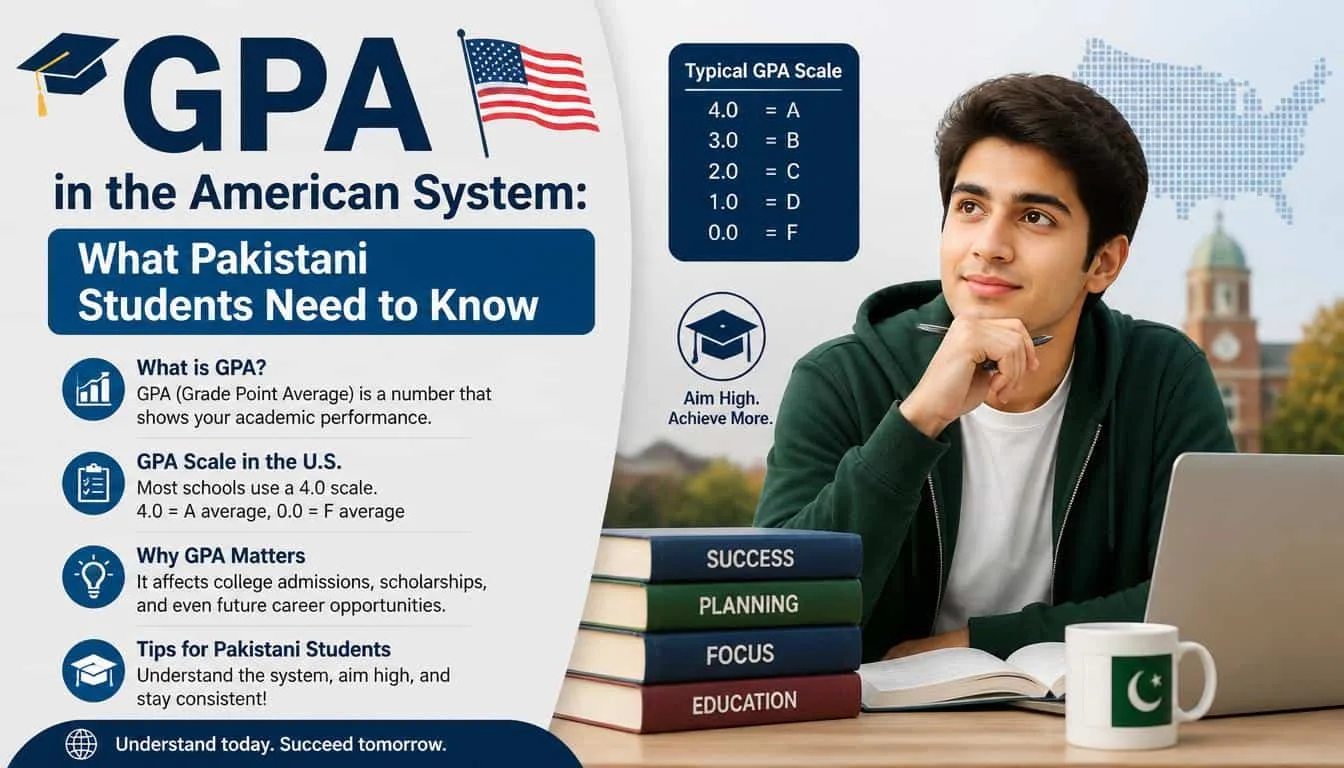
GPA stands for Grade Point Average. In the United States, universities use a 4.0 scale to measure academic performance. Every course carries a letter grade — A, B, C, D, or F — and each letter maps to a numeric point value.
The 4.0 gpa scale is not a percentage. It is a standardized index. An A earns 4.0 points, a B earns 3.0, a C earns 2.0, a D earns 1.0, and an F earns 0.
Most US universities also use plus and minus grades. An A- is 3.7, a B+ is 3.3, a B- is 2.7, and so on. The full scale looks like this:
|
Letter Grade |
GPA Points |
Percentage Range |
|
A |
4.0 |
93–100% |
|
A- |
3.7 |
90–92% |
|
B+ |
3.3 |
87–89% |
|
B |
3.0 |
83–86% |
|
B- |
2.7 |
80–82% |
|
C+ |
2.3 |
77–79% |
|
C |
2.0 |
73–76% |
|
C- |
1.7 |
70–72% |
|
D |
1.0 |
60–69% |
|
F |
0.0 |
Below 60% |
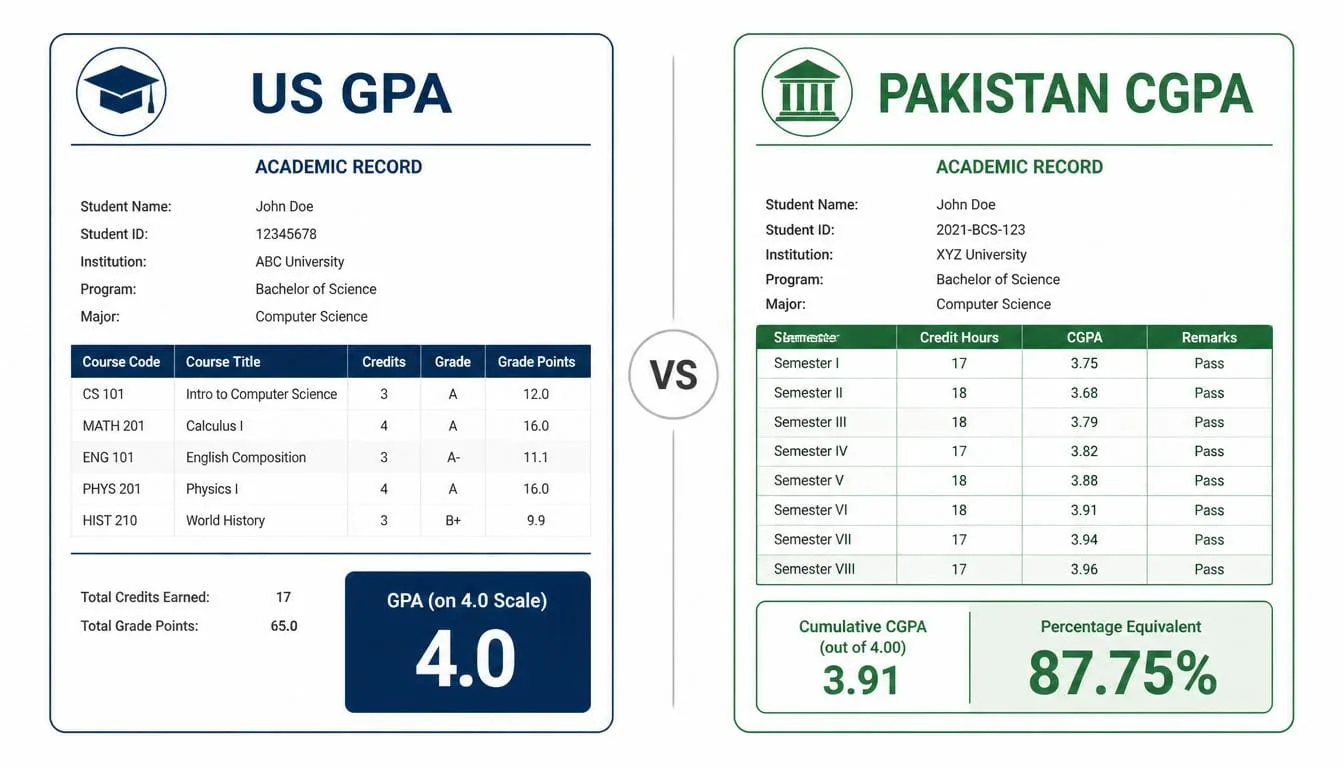
The GPA in the American system is calculated by multiplying each course's grade points by its credit hours, adding the totals, then dividing by total credit hours. The College Board and the American Association of Collegiate Registrars and Admissions Officers (AACRAO) both recognize this as the standard calculation method used across US institutions (AACRAO, 2022).
A GPA of 3.5 or above is generally considered strong. Top graduate programs at research universities typically expect a minimum of 3.0 gpa , and competitive programs often look for 3.5gpa or higher.
GPA in the American System vs GPA in Pakistan
Pakistan uses a different academic measurement structure. Most universities here operate on either a percentage system or a CGPA system on a 4.0 gpa scale, but the grading criteria vary significantly between institutions.
That variation is the core problem. Two students can both hold a 3.2 CGPA from Pakistani universities and have received very different percentage scores, depending on the grading policy of their institution.
|
Factor |
American GPA System |
Pakistani GPA/Percentage System |
|
Standard scale |
4.0 (fixed nationally) |
4.0 CGPA or percentage (varies by institution) |
|
Grading uniformity |
High — standard across most universities |
Low — each university sets its own cutoffs |
|
Letter grade mapping |
Fixed (A = 4.0 universally) |
Varies (A may start at 85% or 90% depending on school) |
|
Credit-hour weighting |
Standard practice |
Used at HEC-recognized universities |
|
International recognition |
Accepted globally without conversion |
Requires conversion for US/UK applications |
|
Plus/minus grades |
Widely used |
Rarely used in Pakistani systems |
The biggest practical difference: a 70% score at one Pakistani university might earn an A grade, while the same 70% earns a B or C at another. American institutions cannot interpret raw Pakistani scores without a standardized conversion.
This is why credential evaluation bodies like World Education Services (WES), Educational Credential Evaluators (ECE), and NACES member organizations exist, they translate international academic records into US-equivalent GPA in the American system.
Why Pakistani Students Need to Convert to the American GPA System
Three situations make this conversion necessary.
US Graduate School Applications
Every US graduate program asks for your GPA in the American system or an equivalent. The Common Application and most university portals have a dedicated GPA field with a 4.0 scale. Pakistani transcripts in percentage or local CGPA format don't fill that field, conversion does.
According to the Institute of International Education (IIE) Open Doors Report 2023, over 8,100 Pakistani students enrolled in US universities in the 2022–2023 academic year. Every one of them needed a converted GPA to complete their application (IIE, 2023).
US Employment Applications
American employers who request GPA, particularly in finance, consulting, engineering, and technology — expect a 4.0 scale number. A Pakistani percentage or CGPA without conversion gives a hiring manager no reference point. A converted GPA in the American system gives them exactly what they need.
Scholarship Eligibility
US-based scholarships, Fulbright included, require GPA in the American system as part of the eligibility check. The Fulbright program, administered by the US Department of State, sets a minimum GPA threshold that Pakistani applicants must meet after conversion (US Department of State, Bureau of Educational and Cultural Affairs, 2023).
How a Pakistani Student Can Calculate GPA in the American System
There are 3 methods Pakistani students use. Each has a different level of accuracy and acceptance.
Method 1: Direct WES or ECE Credential Evaluation
This is the most accepted method for formal applications. World Education Services (WES) and Educational Credential Evaluators (ECE) are NACES-member organizations that review your official transcripts and issue a standardized US GPA equivalent.
The process takes 7 to 10 business days for standard evaluations and costs between $100 and $200 USD depending on the service level. Most US graduate schools and employers accept WES or ECE evaluations without question.
For any serious application, graduate school, federal employment, or professional licensing, use this method.
Method 2: HEC-Recognized GPA Conversion Table
For Pakistani students whose universities use CGPA on a 4.0 scale under HEC Pakistan guidelines, the conversion to American GPA in the American system is relatively direct. HEC follows a grading policy that aligns closely with the US standard:
|
Percentage Score |
HEC CGPA |
US GPA Equivalent |
|
85–100% |
4.0 |
4.0 |
|
80–84% |
3.7 |
3.7 |
|
75–79% |
3.3 |
3.3 |
|
71–74% |
3.0 |
3.0 |
|
68–70% |
2.7 |
2.7 |
|
64–67% |
2.3 |
2.3 |
|
61–63% |
2.0 |
2.0 |
|
58–60% |
1.7 |
1.7 |
|
54–57% |
1.3 |
1.3 |
|
50–53% |
1.0 |
1.0 |
|
Below 50% |
0.0 |
0.0 |
Source: HEC Pakistan Grading Policy, 2020.
If your university follows HEC grading guidelines, you can use this table to state a US GPA equivalent directly on applications, noting the conversion basis.
Method 3: Percentage to 4.0 GPA Formula
For students from institutions that report grades purely as percentages, this formula gives a working estimate:
|
Step |
Action |
Example |
|
1 |
Identify your percentage score |
78% |
|
2 |
Divide by 100 to get a decimal |
0.78 |
|
3 |
Multiply by 4.0 |
0.78 × 4.0 = 3.12 |
|
4 |
Round to 2 decimal places |
3.12 GPA |
This formula is useful for quick estimates. It is not accepted as an official conversion by most US graduate programs. Use it for personal planning, not formal submission.
Step-by-step example for a full transcript:
1. List every course with its credit hours and percentage grade.
2. Convert each percentage to a GPA point using the HEC table or the formula above.
3. Multiply each course's GPA points by its credit hours.
4. Add all the weighted values together.
5. Divide by total credit hours, that is your cumulative GPA in the American system.
|
Course |
Credit Hours |
Percentage |
GPA Points |
Weighted Value |
|
Calculus |
3 |
82% |
3.7 |
11.1 |
|
Physics |
3 |
76% |
3.3 |
9.9 |
|
Programming |
4 |
89% |
4.0 |
16.0 |
|
English |
2 |
71% |
3.0 |
6.0 |
|
Chemistry |
3 |
68% |
2.7 |
8.1 |
Total weighted value: 11.1 + 9.9 + 16.0 + 6.0 + 8.1 = 51.1
Total credit hours: 3 + 3 + 4 + 2 + 3 = 15
GPA in the American System = 51.1 ÷ 15 = 3.41
FAQs
Q: Do all US universities accept self-converted GPA, or do they require a WES evaluation?
It depends on the program. Many universities accept self-reported GPA during the application stage and request official WES or ECE evaluations only after conditional acceptance. Check each program's specific requirement. Law schools and medical programs almost always require a NACES-member evaluation.
Q: My Pakistani university uses a 4.0 CGPA scale. Do I still need to convert?
If your university follows HEC grading guidelines, your CGPA already maps closely to US GPA standards. You can state your GPA directly on applications and note that your institution uses an HEC-regulated 4.0 scale. Some US programs will still request a WES evaluation for verification.
Q: Is a 3.2 Pakistani CGPA considered good in the US system?
Yes. A 3.2 GPA in the American system is above the minimum threshold for most US graduate programs, which typically require a 3.0. Competitive programs at research universities prefer 3.5 or higher. Context matters too, a 3.2 from a rigorous Pakistani engineering program carries weight.
Q: How long does a WES evaluation take and how much does it cost?
Standard WES evaluations take 7 business days and cost approximately $100 USD for a basic course-by-course report. Rush processing takes 3 business days at a higher fee. ECE offers similar pricing. Check wes.org and ece.org for current rates, as fees change periodically.
Q: Can I convert my GPA myself for a Fulbright application?
The Fulbright program accepts self-reported GPA during the initial application. However, if selected, you will need official documentation. The US Embassy in Pakistan and the Fulbright program office provide specific guidance on transcript submission for Pakistani applicants. Check the current cycle's application instructions at the US Embassy Islamabad website.
Q: What GPA in the American system do I need for a full scholarship to a US university?
Most fully funded graduate programs, including PhD programs with teaching assistantships, require a minimum converted GPA of 3.0, with competitive applicants averaging 3.5 to 3.8. STEM PhD programs at top-50 universities typically admit students with converted GPAs above 3.6. Undergraduate scholarships vary widely by institution and program.
Personal opinion
The GPA conversion question trips up Pakistani students not because the math is hard, it isn't, but because nobody explains the full picture early enough.
Pakistani universities produce genuinely strong graduates. The problem is a documentation gap, not an academic one. A student with a 78% average from NUST or LUMS is competitive for US programs. But if they can't state that clearly in American terms, they lose ground to students with identical ability who simply formatted their credentials correctly.
My suggestion: treat GPA conversion as part of your application preparation, not an afterthought. If you plan to apply to any US program or employer within the next two years, get a WES evaluation done now. It takes two weeks and under $150. It removes an uncertainty from every future application you submit.
Know your number. State it clearly. The rest of your application can do the rest.