
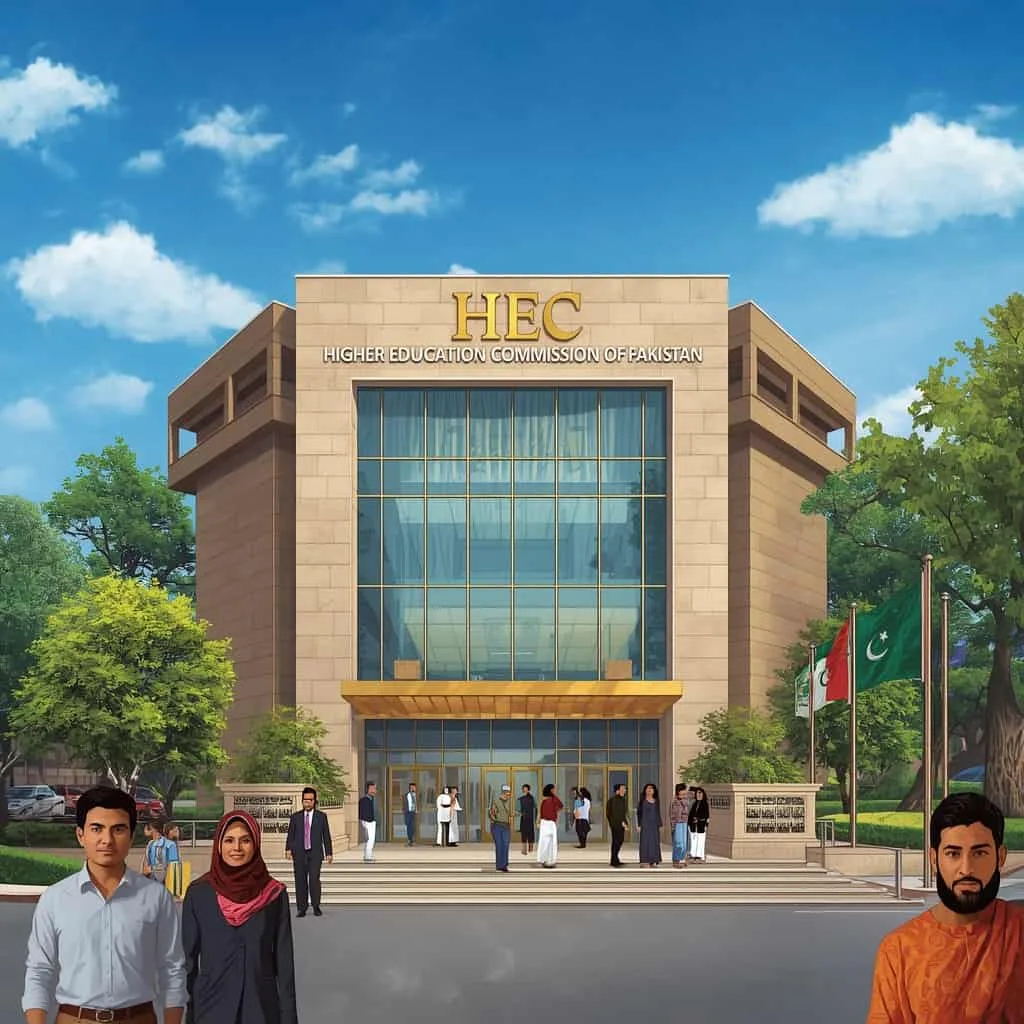
HEC Pakistan: History, Importance, Student Benefits, and Policy Impact
Pakistan has over 230 degree-awarding institutions. Millions of students enroll every year. And yet, for decades, higher education in the country lacked a single, unified body to set standards, distribute funding, and push universities toward global relevance.
That changed when HEC Pakistan came into existence. Since then, it has reshaped the landscape of higher education in ways that touch every student, faculty member, and institution across the country.
Let's look at the full picture, where it came from, what it does, and why it matters to you.
What Is HEC Pakistan? A Brief History and Foundation
HEC Pakistan, the Higher Education Commission of Pakistan, is the federal regulatory authority responsible for overseeing, regulating, and funding higher education institutions across the country.
It was established on September 11, 2002, through the Higher Education Commission Ordinance 2002, replacing the University Grants Commission (UGC) that had existed since 1974. The UGC had served its time but struggled to keep pace with Pakistan's rapidly growing higher education demands.
The commission launched under the leadership of Dr. Atta-ur-Rahman, a world-renowned chemist and science policy expert, who served as its founding chairman. Under his direction, HEC Pakistan launched one of the most ambitious higher education reform programs in the country's history.
The timing was deliberate. Pakistan's university enrollment rate in 2002 was alarmingly low, research output was minimal, and international academic recognition of Pakistani degrees was inconsistent at best.
According to the HEC Annual Report 2022, the number of higher education institutions in Pakistan grew from 135 in 2002 to over 230 by 2022, with student enrollment increasing from approximately 275,000 to over 1.8 million, a staggering transformation driven largely by HEC policies and funding (HEC Pakistan Annual Report, 2022).
That is not just growth. That is a revolution in access.
Core Mandate of HEC Pakistan
HEC Pakistan operates under four core responsibilities:
• Regulation: Recognizing and accrediting degree programs and institutions
• Funding: Allocating government grants to public universities
• Quality Assurance: Setting academic standards and curriculum benchmarks
• Research Promotion: Funding indigenous research and international academic collaboration
Why HEC Pakistan Is Important for Students
If you are a student in Pakistan, whether you're in your first undergraduate year or finishing a PhD, HEC Pakistan affects your academic life more than you probably realize.

Here is why it matters:
Degree Recognition and Validity
One of the most critical functions HEC Pakistan performs is degree attestation and recognition. When you graduate from a Pakistani university, your degree only carries weight internationally if your institution is HEC-recognized.
Without that recognition, your degree may not be accepted for jobs abroad, foreign graduate programs, or professional licensing in other countries. HEC attestation is the stamp that tells the world your qualification is legitimate.
Academic Quality Standards
HEC Pakistan sets curriculum frameworks for degree programs across disciplines, engineering, medical sciences, social sciences, business, and more. This means your degree meets a nationally standardized benchmark, regardless of which university you attend.
That standardization protects you. It ensures a Computer Science degree from a public university in Peshawar meets the same core requirements as one from a university in Karachi.
Digital and Research Access
Through its Digital Library Program, HEC Pakistan provides students and faculty free access to thousands of international academic journals, research databases, and e-books, including platforms like JSTOR, Springer, and Elsevier.
Without HEC, access to this volume of research would cost institutions millions of dollars annually. The HEC Digital Library alone has saved Pakistani universities an estimated PKR 4 billion in subscription costs, according to HEC's own program documentation (HEC Digital Library Program Overview, 2023).
How HEC Pakistan Helps Students: Scholarships and Educational Support
This is where HEC Pakistan directly changes individual lives. The commission runs some of the largest and most competitive scholarship programs available to Pakistani students, both for study within Pakistan and abroad.
|
Scholarship Program |
Level |
Destination |
Target Group |
|
Need-Based Scholarships (NBS) |
Undergraduate |
Pakistan |
Financially disadvantaged students |
|
Indigenous PhD Fellowship |
PhD |
Pakistan |
MS/MPhil graduates |
|
Overseas Scholarships |
MS / PhD |
Abroad (Europe, USA, China) |
Top academic performers |
|
HRDI Faculty Development |
MS / PhD |
International |
University faculty members |
|
PM Youth Laptop Scheme (affiliated) |
Undergraduate |
Pakistan |
Enrolled university students |
|
IRSIP (Research Internship) |
PhD |
International Labs |
PhD scholars mid-program |
Need-Based Scholarships (NBS)
The Need-Based Scholarship Program covers tuition, hostel, and monthly stipend for financially deserving undergraduate students enrolled in HEC-recognized institutions. In the 2021–2022 cycle, over 11,000 students received NBS support across Pakistan (HEC Pakistan NBS Annual Data, 2022).
Indigenous PhD Fellowship Program
For students pursuing doctoral degrees within Pakistan, HEC Pakistan offers the Indigenous PhD Fellowship. This program covers full tuition and provides a monthly stipend to support researchers working on disciplines critical to national development, STEM fields, agriculture, education, and social sciences.
Overseas Scholarships
Perhaps the most competitive of all, the HEC Overseas Scholarship Program sends Pakistan's brightest students to top universities in Europe, North America, China, and beyond for fully funded MS and PhD degrees. Thousands of scholars have returned with international qualifications and gone on to lead Pakistani universities, research institutions, and government bodies.
This program has done more for Pakistan's academic capacity than almost any other single initiative. It is the reason many of today's university professors hold degrees from institutions like Oxford, MIT, and the University of Toronto.
IRSIP — International Research Support Initiative
The International Research Support Initiative Program (IRSIP) allows Pakistani PhD scholars enrolled at local universities to spend 6 months at a leading international research institution. This exposes them to global research environments without requiring full relocation. It bridges the gap between domestic and international academic standards practically and affordably.
The Impact of HEC Pakistan's Policies on Higher Education
Policies on paper mean nothing unless they change things on the ground. HEC Pakistan's track record shows a mixed but overall significant impact on the country's higher education ecosystem.
Expansion of University Infrastructure
One of the most visible policy impacts has been institutional expansion. HEC Pakistan funded the construction and upgrade of dozens of universities in underserved regions, including Balochistan, Khyber Pakhtunkhwa, and Gilgit-Baltistan, areas that previously had almost no higher education access.
This was not charity. It was a deliberate policy to reduce the geographic inequality in education access that had kept rural students out of universities for generations.
Research Output and Global Rankings
When HEC Pakistan launched, Pakistani universities produced fewer than 1,000 research publications annually. By 2021, that number exceeded 30,000 research publications per year, according to the Scimago Journal and Country Rankings, a direct result of HEC's research funding, PhD fellowship programs, and journal access initiatives (Scimago Institutions Rankings, 2022).
That is a 30-fold increase in two decades. It's the kind of number that makes the international academic community take notice.
Faculty Development Policies
HEC Pakistan introduced a policy requiring all university faculty to hold at least an MS or MPhil degree, and for senior faculty, a PhD became mandatory. This raised the baseline academic qualification of professors across the country significantly.
The HRDI (Human Resource Development Initiative) funded thousands of faculty members to complete doctoral degrees abroad, bringing international academic standards back to Pakistani classrooms.
Challenges and Criticisms
No institution is without its critics. HEC Pakistan has faced legitimate questions over the years about funding distribution equity, bureaucratic delays in scholarship disbursements, and the pace of quality improvement at private institutions.
Independent researchers and policy analysts have noted that while access to higher education has expanded dramatically, graduate employability and research-to-industry translation remain areas requiring stronger policy attention (Hoodbhoy, P., 2009; Pakistan Education Statistics Report, 2023).
These are real issues. A growing system brings growing pains. But the trajectory, more institutions, more scholars, more research, points in the right direction.
FAQs About HEC Pakistan
Q: Is HEC Pakistan a government body?
Yes. HEC Pakistan is a federal regulatory authority operating under the Government of Pakistan. It functions autonomously in academic matters but receives its funding through the federal budget. It reports to the Ministry of Federal Education and Professional Training.
Q: How do I apply for an HEC scholarship?
All HEC Pakistan scholarship applications are processed through the official HEC website at hec.gov.pk. Each program has its own eligibility criteria, deadlines, and application portal. Students must be enrolled in or have graduated from an HEC-recognized institution to qualify.
Q: What is HEC degree attestation and why do I need it?
HEC degree attestation is the official verification of your academic credentials by HEC Pakistan. It confirms your degree is genuine and your institution is recognized. You need it for jobs abroad, immigration processes, foreign university admissions, and many government positions within Pakistan.
Q: Does HEC Pakistan recognize private universities?
Yes. HEC Pakistan recognizes and regulates both public and private universities. A complete list of recognized institutions is available on the HEC website. If a private university is not on this list, its degrees may not be considered valid for official purposes.
Q: Can foreign students benefit from HEC Pakistan programs?
HEC Pakistan primarily serves Pakistani nationals and institutions. However, certain bilateral agreements allow students from specific countries, particularly China, Turkey, and OIC member states, to benefit from exchange programs and joint research initiatives facilitated through HEC.
Q: What is the HEC Digital Library and how do students access it?
The HEC Digital Library provides free access to international research journals and academic databases for students and faculty at HEC-recognized institutions. Access is typically provided through your university's library portal using your institutional login credentials.
Final Thoughts
HEC Pakistan is not a perfect institution, no regulatory body ever is. But its role in transforming Pakistan's higher education landscape over the past two decades is undeniable.
From fewer than 135 universities to over 230. From 275,000 enrolled students to 1.8 million. From under 1,000 research publications a year to over 30,000. These are not small numbers. They represent real students, real researchers, and real opportunities that would not have existed without a centralized higher education authority driving the change.
If you are a student in Pakistan, understanding what HEC Pakistan does, and how to use its programs, is one of the smartest things you can do for your academic future. From scholarships to degree attestation to research access, the commission exists to serve you.