
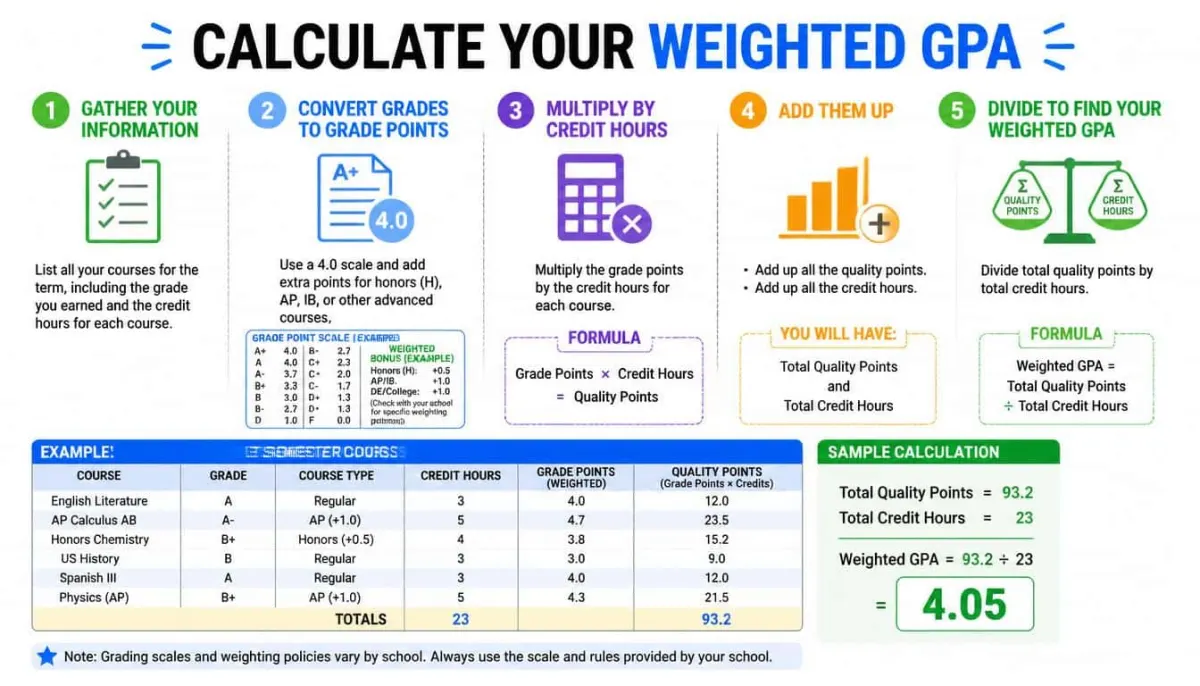
How to calculate weighted GPA: step-by-step formula
Key takeaways
-
Weighted GPA accounts for course difficulty by adding extra points for AP, IB, and Honors classes.
-
The standard formula involves converting letter grades to a 5.0 (or higher) scale and averaging them.
-
Calculate your weighted average by dividing total grade points by the number of attempted credits.
-
Colleges often recalculate your GPA using their own internal weighting systems regardless of your high school's method.
The high-stakes math of high school transcripts
Imagine two students, Alex and Jordan. Alex earns an 'A' in standard English, while Jordan earns a 'B' in AP English Literature. In a traditional unweighted system, Alex looks like the higher achiever with a 4.0 compared to Jordan's 3.0. However, most college admissions officers know that Jordan tackled a college-level workload. This is where learning how to calculate weighted GPA becomes essential. It levels the playing field by rewarding students who take on academic rigor.
The frustration many families feel stems from the lack of a universal standard. Some schools use a 5.0 scale, others use 6.0, and some don't weight at all. This lack of consistency can make your transcript feel like a riddle. This guide breaks down the exact mechanics of the weighted system, providing you with a manual formula you can use to verify your school's data or project your final standing before graduation.
Important: The National Association for College Admission Counseling (NACAC) report on GPA importance
Understanding the difference between weighted and unweighted GPA
Before we crunch the numbers, we must distinguish between your two GPA "identities." An unweighted GPA is the most basic representation of your grades. It treats every class exactly the same, whether it is "Introduction to Art" or "Quantum Physics." On this scale, an 'A' is worth 4 points, a 'B' is 3, a 'C' is 2, and a 'D' is 1.
A weighted GPA changes the math to reflect the "weight" of the challenge. Most American high schools add an extra 1.0 point for Advanced Placement (AP) and International Baccalaureate (IB) courses. Many also add 0.5 points for Honors or Accelerated classes. This is why you often see students boasting a 4.5 or 4.8 GPA. They are operating on a scale that acknowledges the increased time, effort, and complexity required by advanced curricula.
According to a [STAT: insert 2023 report data on percentage of high schools using weighted GPAs], a significant majority of secondary schools now utilize some form of weighting to help students remain competitive in the admissions process.
The standard 5.0 weighting scale
To understand how to calculate weighted GPA, you first need to know the point values assigned to each grade based on course type. While your specific school might vary slightly, the "Standard 5.0 Scale" is the most common benchmark used across the United States.
| Letter Grade | Standard Course | Honors (+0.5) | AP / IB (+1.0) |
| A | 4.0 | 4.5 | 5.0 |
| B | 3.0 | 3.5 | 4.0 |
| C | 2.0 | 2.5 | 3.0 |
| D | 1.0 | 1.5 | 2.0 |
| F | 0.0 | 0.0 | 0.0 |
Notice that failing grades (F) typically do not receive extra weight. You must pass the course to earn the "rigor bonus." If you are taking Dual Enrollment courses through a local community college, these are usually treated similarly to AP courses, though you should always verify with your registrar.
The step-by-step weighted GPA formula
Calculating this manually ensures you have full transparency over your academic standing. Follow these four steps to find your current weighted average.
Step 1: List your courses and grades
Write down every class you took during the semester or year. Next to each course, write the final letter grade you received. It is helpful to group them by "Level" (Standard, Honors, or AP).
Step 2: Assign point values
Use the 5.0 scale chart provided above to convert your letter grades into points. Be careful here; a common mistake is forgetting to add the 0.5 or 1.0 bonus to the specific advanced classes.
Step 3: Total the grade points
Add all the point values together. This sum represents your "Total Grade Points." For example, if you took five classes and earned 4 points in each, your total is 20.
Step 4: Divide by the number of courses
Take your Total Grade Points and divide by the total number of classes you listed in Step 1.

A real-world calculation example
Let's look at a sample student, Sarah, who is taking a mix of course levels. By walking through her numbers, the process of how to calculate weighted GPA becomes much clearer.
Sarah's Semester:
-
AP Psychology: Grade A (5.0 points)
-
Honors Algebra II: Grade B (3.5 points)
-
Standard Chemistry: Grade A (4.0 points)
-
Standard Spanish II: Grade A (4.0 points)
-
AP English: Grade C (3.0 points)
The Math:
-
Total Points: $5.0 + 3.5 + 4.0 + 4.0 + 3.0 = 19.5$
-
Total Classes: 5
-
Calculation: $19.5 \div 5 = 3.9$
In this scenario, Sarah's weighted GPA is 3.9. If she had used an unweighted scale, her GPA would only be 3.4. The weighting reflects that her 'B' and 'C' were earned in significantly harder environments.

Why schools and colleges view GPA differently
You might spend hours mastering how to calculate weighted GPA, only to find that your dream university calculates it differently. This is one of the "hidden" aspects of college admissions. Many selective universities, such as the University of California system or Ivy League schools, perform an "Internal Recalculation."
Why do they do this? Because one school might give a +1.0 weight for an Honors class, while another only gives +0.5. To compare students fairly, admissions officers often strip away the high school's weighting and apply their own uniform system. Some colleges only look at "core" subjects (Math, Science, English, Social Studies, Foreign Language) and ignore electives like Physical Education or Woodshop.The Common Data Set Explained: GPA, Test Scores, and What Colleges Really Want
Common mistakes to avoid in your calculation
When students try to determine their standing, a few recurring errors can lead to misleading results.
-
Including non-credit courses: If you are a lab assistant or have a "study hall" period that doesn't award a grade, do not include it in your divisor.
-
Miscalculating mid-year grades: Unless your school uses "Quality Points" for quarters, only use semester or final year-end grades for your official calculation.
-
Assuming all "Advanced" classes are weighted: Sometimes "Advanced Math" is just a faster-paced standard class and doesn't carry the "Honors" weight. Check your school's official course catalog.
-
Ignoring credit hours: If your school uses a credit-hour system (where a lab is 4 credits and a lecture is 3), you must multiply the grade points by the credits before totaling.
Strategic tips for boosting your weighted GPA
If you are looking to improve your academic profile, simply taking more classes isn't always the answer. Quality often beats quantity.
-
Protect your "unweighted" foundation: Don't take so many AP classes that your grades drop to 'C's. A 'B' in an AP class (4.0 weighted) is usually better than an 'A' in a standard class (4.0 weighted) because it shows rigor, but a 'C' can start to hurt your overall average.
-
Balance your schedule: Try to take weighted courses in subjects where you have a natural affinity. If you struggle with math, taking AP Calculus just for the weight might backfire.
-
Use summer bridge programs: Some schools allow you to take honors-level prerequisites over the summer, freeing up space for more weighted electives during the school year.
Last updated: October 2023 | This content is for informational purposes only.
Frequently asked questions
Q: Is a 4.5 GPA good?
A: Yes, a 4.5 GPA is excellent. Since it is above the traditional 4.0 "perfect" unweighted score, it indicates that you are not only earning high grades but also challenging yourself with Honors, AP, or IB coursework. This is highly attractive to competitive universities.
Q: Can a weighted GPA be lower than an unweighted GPA?
A: No, it is mathematically impossible for a weighted GPA to be lower than an unweighted one, provided the same classes are used. Weighting only adds points; it never subtracts them. If your weighted score looks lower, there is likely a calculation error.
Q: Do colleges look at weighted or unweighted GPA more?
A: Most colleges look at both. They use the unweighted GPA to see your raw performance and the weighted GPA (or their own recalculated version) to understand the level of difficulty you chose to face. Rigor is a key factor in elite admissions.
Q: How do I calculate GPA with plus and minus grades?
A: If your school uses +/- (like B+ or A-), you must adjust the base points. Typically, an 'A-' is 3.7 and a 'B+' is 3.3. You then add the weight (e.g., +1.0 for AP) to that specific decimal value.
Q: Does a 5.0 GPA mean I got all A's in AP classes?
A: Generally, yes. On a 5.0 scale, achieving a perfect 5.0 requires earning an 'A' in every single class, and every one of those classes must be an AP or IB level course.
Written by: Dr. Aris Thorne | Senior Admissions Strategist
Reviewed by: Sarah Jenkins, M.Ed., School Counselor
Bio: Dr. Aris Thorne has spent over 15 years helping students navigate the complexities of the American grading system. As a former admissions officer for a Tier-1 university, he specializes in transcript analysis and academic planning.