
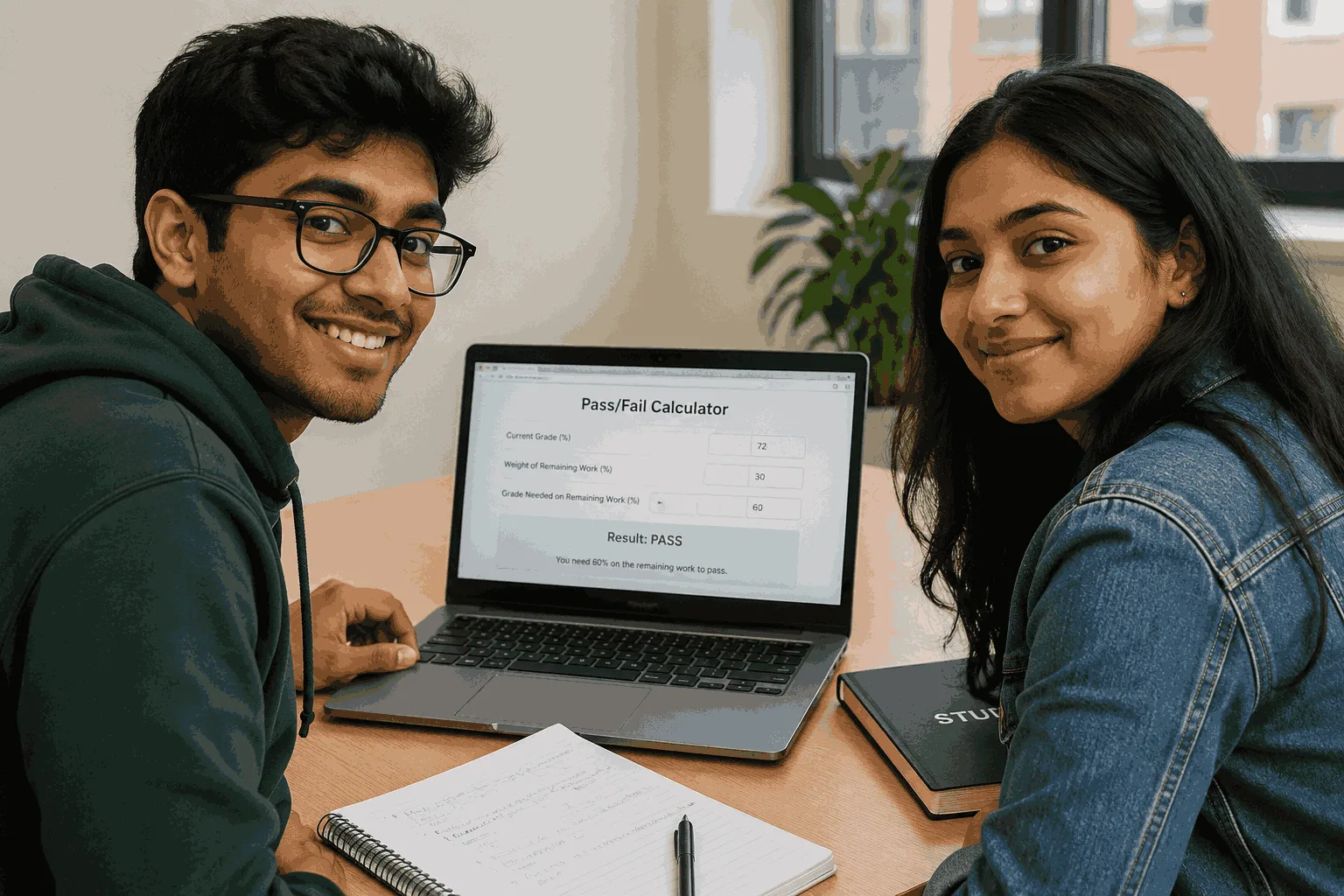
Pass/Fail Calculator, Exam Strategies & Student Success Guide
Every student, at some point, has stared at their exam results and thought: "Did I pass?" It sounds like a simple question, but the answer involves more than just a number on a page. Understanding your score, what caused your result, and how to do better next time is the real journey.
This guide covers everything, from using a pass/fail calculator correctly, to the real factors behind academic failure, to the strategies that top students quietly use every semester. Whether you just finished an exam or you are preparing for one, this guide has something useful for you.
According to the National Center for Education Statistics (NCES), approximately 40% of college students in the U.S. who start a 4-year degree do not complete it within 6 years, largely due to academic struggles and poor preparation strategies.
What Is a Pass/Fail Calculator — and How Does It Work?
A pass/fail calculator is a simple tool that helps you determine whether your exam score meets the minimum threshold required to pass a course or assessment. You input your score and the passing mark, and it tells you instantly whether you passed, failed, or how many marks you needed.
Most educational institutions set a passing grade at 50% or 40%, depending on the level and subject. Some competitive programs require 60% or higher. A pass/fail calculator eliminates the mental math and tells you exactly where you stand.
In the UK, many universities use a 40% pass threshold for undergraduate courses, while postgraduate programs often require 50% (UCAS / individual university policies).
How to Use a Pass/Fail Calculator — Step by Step
Step 1: Enter your raw score (e.g., 42 out of 70).
Step 2: Enter the total marks possible.
Step 3: Input the passing percentage (e.g., 50%).
Step 4: The calculator converts your score to a percentage and compares it to the threshold.
Step 5: You get a clear PASS or FAIL result, plus how many marks you were above or below the cut-off.
Many online tools, including those on educational websites like Khan Academy, Gradetracker, and university portals, include this functionality. You can also build your own with a simple formula: (Your Score ÷ Total Marks) × 100. If that number is greater than or equal to the passing percentage, you passed.
Always check your institution's specific grading rubric. Some schools use weighted grading, where coursework, midterms, and finals carry different percentages toward your final grade.
What Are the Real Factors Behind Your Exam Failure?
Failing an exam rarely happens for just one reason. It is usually a combination of factors, some obvious, some surprisingly subtle. Understanding them honestly is the first step to fixing them.
Below are the most common and research-supported reasons students fail, ranked from most to least frequently cited in academic studies.
A 2022 report by the Education Policy Institute found that poor study habits and lack of preparation, not lack of intelligence, were the top causes of academic underperformance in secondary and post-secondary students.
1. Poor Time Management
This is the number-one reason. Students who leave studying to the last night fall into "cramming mode", which research shows is highly ineffective for long-term retention. The brain needs spaced repetition, not one-night marathons.
A study published in Psychological Science found that students who spread study sessions over multiple days retained information 50% more effectively than those who crammed in one session.
2. Lack of Understanding vs. Memorization
Memorizing facts without understanding the underlying concept is a trap. Exams, especially at university level, test your ability to apply knowledge, not just recall it. If you memorized the formula but cannot use it in a new context, you are in trouble.
3. Test Anxiety
This is more common than most students admit. Test anxiety affects approximately 16–20% of students globally, according to research cited by the American Psychological Association (APA). Symptoms include blanking out, racing heart, and poor decision-making during the exam, even when the student knows the material.
4. Poor Exam Technique
Many students lose marks not because they do not know the answer, but because they misread questions, run out of time, or fail to structure answers properly. Reading every question carefully, managing time per question, and answering what is actually asked are skills in themselves.
5. Inconsistent Attendance and Engagement
Skipping lectures or classes creates knowledge gaps that are extremely hard to fill on your own. A report from the Higher Education Academy (UK) found a direct positive correlation between class attendance and academic performance.
6. Poor Physical and Mental Health
Sleep deprivation alone can impair cognitive function significantly. According to the National Sleep Foundation, students who sleep fewer than 6 hours the night before an exam perform notably worse on memory and reasoning tasks. Add poor nutrition and chronic stress, and you have a recipe for failure.
7. Ineffective Study Habits
Highlighting everything, re-reading notes passively, and studying in front of the TV are all ineffective. Research from cognitive science consistently shows that active recall, self-testing, and teaching concepts out loud produce far better results.
How to Pass in Any Exam — Practical Strategies That Actually Work
Passing exams is not about being the smartest person in the room. It is about preparation, strategy, and execution. Here is a clear, proven roadmap.
Start Early and Use Spaced Repetition
Do not wait until the week before your exam to start studying. Begin at least 3–4 weeks in advance and use a spaced repetition system (SRS). This technique involves reviewing material at increasing intervals, day 1, day 3, day 7, day 14, to lock information into long-term memory.
Apps like Anki and Quizlet are built on this principle and are widely used by medical and law students who deal with enormous volumes of information.
Use Active Recall, Not Passive Review
Close your notes and try to recall what you just studied. This retrieval practice is far more powerful than re-reading. Make flashcards, take practice tests, or write everything you remember from a topic on a blank page. The act of struggling to remember is what builds memory.
Understand the Exam Format
Before you study anything, understand what kind of exam you are dealing with. Is it multiple choice, essay, practical, or oral? Each format requires a different preparation strategy. For multiple-choice exams, elimination techniques matter. For essays, planning your argument structure before writing saves time.
Practice with Past Papers
This is non-negotiable. Past exam papers are the single best revision tool available. They show you what the examiner values, how questions are framed, and which topics come up repeatedly. Most universities and examination boards (like Cambridge Assessment or College Board) publish past papers publicly.
Focus on High-Yield Topics
Not all topics carry equal weight. Look at past papers and your syllabus to identify which areas are tested most frequently. Spend 70% of your time on these and 30% on the rest. Smart prioritization often separates a B student from an A student.
Manage Exam Day Like a Professional
Arrive early. Read all questions before you start writing. Allocate time per question before you begin. Answer the easiest questions first to build momentum. Review your answers if time permits. These simple habits prevent unnecessary mark losses.
Remember: Failing one exam does not define your intelligence or your future. It is data. Use it to adjust your approach
What Strategies Do Intelligent and Hardworking Students Use to Secure Good Grades?
Top students are not always more talented, they are usually more strategic. Here is what sets them apart from the rest of the class, based on academic research and behavioral patterns observed in high-achieving students.
A 2020 study in the Journal of Educational Psychology found that self-regulated learning, planning, monitoring, and evaluating your own study habits, was a stronger predictor of academic success than IQ scores.
They Set Specific, Measurable Goals
Instead of vaguely saying "I will study chemistry tonight," a high achiever says "I will complete chapters 4 and 5, do 20 practice questions, and review my flashcards by 10 PM." Specificity creates accountability and direction.
They Build Consistent Daily Habits
High-performing students study every day, even if just for 30–60 minutes. Consistency beats intensity. Small daily inputs compound over a semester in ways that last-minute cramming simply cannot replicate.
They Ask Questions — Without Embarrassment
Top students use office hours, email their professors, and form study groups. They understand that asking a question is a sign of intellectual engagement, not weakness. Most teachers are genuinely impressed by students who seek clarification.
They Use Multiple Learning Resources
Lecture notes are the starting point, not the end point. Top students supplement with textbooks, YouTube explanations (like 3Blue1Brown for maths or CrashCourse for sciences), research papers, and peer discussions. Diversity of input deepens understanding.
They Practice Metacognition
Metacognition simply means "thinking about your thinking." After a study session, top students ask themselves: What did I understand well? Where am I still confused? What should I review tomorrow? This self-awareness keeps their study sessions focused and efficient.
They Prioritize Sleep, Exercise, and Nutrition
This is not optional advice, it is science. The Harvard Medical School Division of Sleep Medicine has published extensively on how sleep consolidates memory. Students who sleep 7–9 hours consistently retain 40% more information than sleep-deprived peers.
Regular physical exercise has also been shown to improve concentration and reduce anxiety, both of which directly impact academic performance. Even a 20-minute walk before a study session can meaningfully boost cognitive focus.
They Learn from Their Mistakes — Immediately
After every test or mock exam, successful students review every wrong answer and understand exactly why it was wrong. This targeted analysis prevents them from repeating the same errors. It is painful, honest work, and it pays off.
They Minimize Distractions Strategically
Top students do not rely on willpower alone. They use practical tools: phone in another room, website blockers like Cold Turkey or Freedom, studying in libraries rather than bedrooms, and telling friends and family about their study schedule to reduce interruptions.
Frequently Asked Questions (FAQs)
Q: What is the passing percentage in most schools and universities?
Most schools set the passing mark at 40% to 50%, depending on the level of education and institution policy. Undergraduate university courses in many countries require 40–50%, while professional certification exams often require 60–70%. Always check your specific institution's grading policy.
Q: Can I pass a course if I fail one exam?
Yes, in most cases. Many academic systems use continuous assessment, meaning your coursework, assignments, quizzes, and class participation also contribute to your final grade. A single failed exam may not doom you, especially if you have been performing well in other assessments. Talk to your instructor or academic advisor promptly.
Q: How accurate is an online pass/fail calculator?
Online pass/fail calculators are generally very accurate for straightforward scenarios (flat grade thresholds). However, they may not account for weighted grading, bell curves, or departmental grading adjustments. Use them as a guide, and confirm with your official grade sheet or academic office.
Q: Is cramming ever a good strategy?
Cramming can work for short-term recall, meaning it might help you get through tomorrow's quiz. But research consistently shows it is ineffective for long-term retention or complex understanding. If you are cramming, focus on the highest-priority topics, make quick summary notes, and get enough sleep before the exam.
Q: How do I deal with exam anxiety?

Exam anxiety is real and widely studied. Practical strategies include deep breathing exercises, visualizing a successful exam performance before you start, and reframing anxiety as excitement (a technique supported by research from Harvard Business School). If anxiety is severe and persistent, speaking with a school counselor or mental health professional is strongly recommended.
Q: How many hours should I study per day for exams?
Quality beats quantity every time. Research suggests 3–5 focused hours of active studying per day is more effective than 8–10 hours of passive reading. Use the Pomodoro Technique: 25 minutes of focused study, 5-minute break, repeat. After four cycles, take a longer 20–30 minute break.
Q: Does the pass/fail grading option affect GPA?
In most U.S. universities, taking a course pass/fail means a passing grade does not affect your GPA (it is not counted), but a failing grade does. This option is often available for elective courses. The rules vary by institution, so review your academic handbook carefully before selecting this option.
Personal Opinion: What Most Exam Advice Gets Wrong
Here is something most exam guides will not tell you plainly: the system is imperfect. A single 3-hour exam measuring years of learning is, to be honest, a crude instrument. Some brilliant people perform poorly in timed, high-pressure environments. Some average learners do brilliantly because they have test-taking instincts.
That said, exams are not going away. They are a gatekeeping mechanism, for better or worse, and learning to navigate them is a life skill. The students who do best are not always those who know the most. They are those who understand the game.
What genuinely separates good students from great ones is not intelligence, it is consistency, self-honesty, and the willingness to change strategies when something is not working. If you studied hard and still failed, the answer is not to study harder next time. It is to study differently.
Opinion: The most underrated exam skill is simply reading the question carefully and answering what is actually being asked, not what you hoped they would ask.
Finally, do not let a grade define your self-worth. Some of the most successful people in the world, from Steve Jobs to JK Rowling, did not have straightforward academic paths. Exams measure a narrow slice of human capability. Do your best, learn from the results, and keep going.
Conclusion
A pass/fail calculator is a simple but useful tool that removes the guesswork from exam results. But far more important than calculating whether you passed is understanding why you got the result you did, and using that understanding to improve.
Failure in exams is almost never about intelligence. It is about preparation, strategy, habits, and sometimes circumstances. The good news is that all of those are things you can change.
Use spaced repetition, practice active recall, attempt past papers, prioritize your health, and study with intention rather than just effort. These are not magical tricks, they are evidence-based practices used by high-achieving students all over the world.
Whether you are using a pass/fail calculator to check today's results or planning how to ace your next big exam, the most important thing is this: stay honest with yourself, stay consistent, and keep learning.