
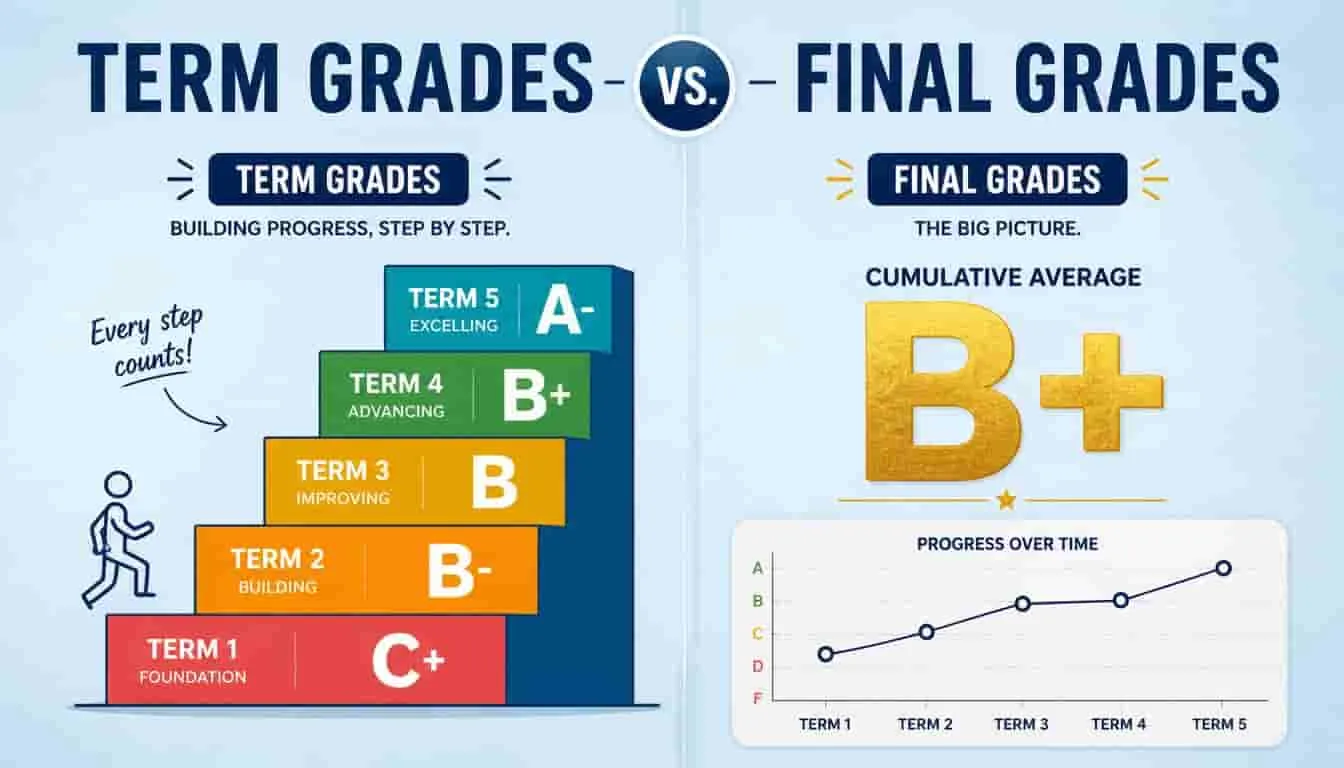
Term Grade vs Final Grade: Key Differences, Calculations, and Career Impact
Every student has been there, staring at a grade on a report card and wondering: "Is this my term grade or my final grade? And does it actually matter?"
The short answer is yes, it matters more than most people think. The long answer is what this article is about.
Understanding how a term grade works, how it differs from a final grade, and how both affect your academic and professional future is knowledge every student deserves to have, early, clearly, and without confusion.
Let's get into it.
Difference Between Term Grade and Final Grade
A term grade and a final grade sound similar but serve very different purposes in your academic life. Mixing them up is one of the most common misunderstandings students have, and it can lead to some unpleasant surprises at the end of a semester.
What Is a Term Grade?
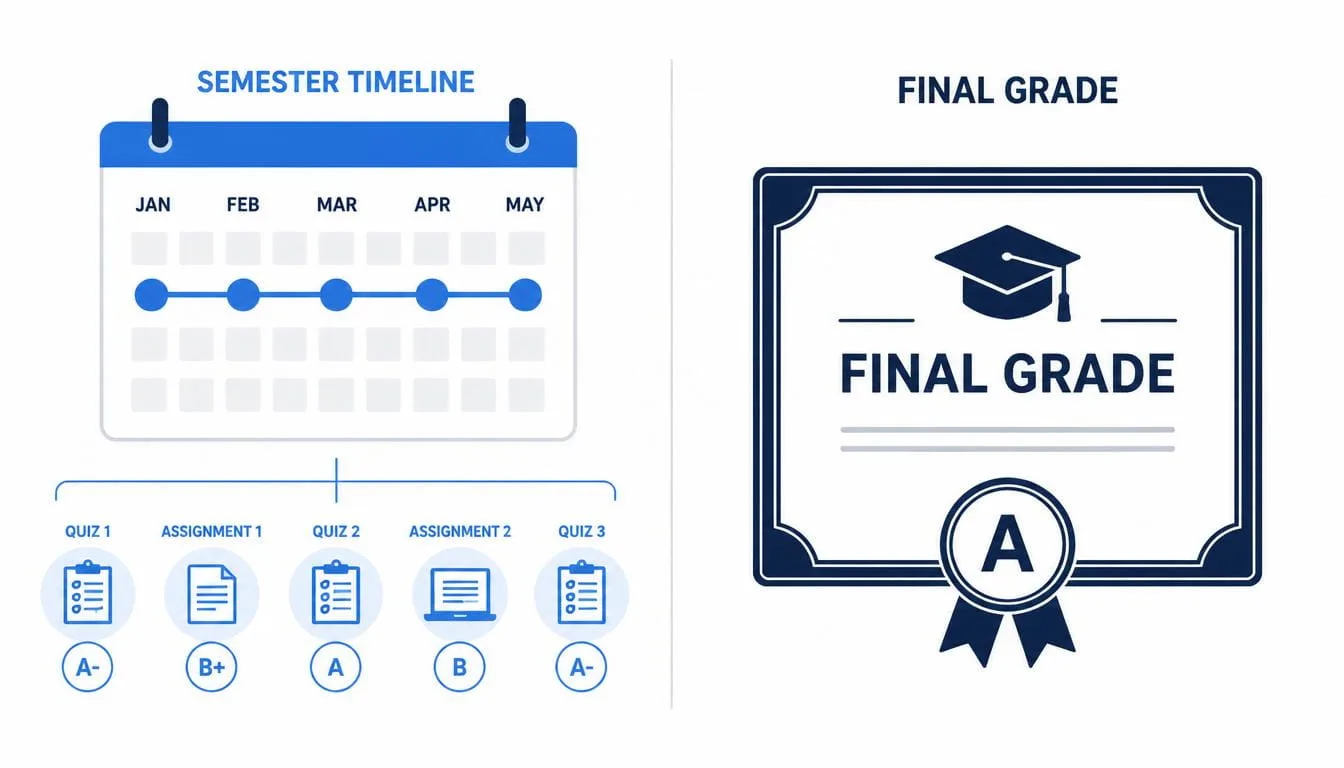
A term grade reflects your performance during a specific academic term or semester. It captures your work over a defined period, usually 4 to 6 months, and includes multiple components: quizzes, assignments, midterm exams, class participation, lab work, and sometimes attendance.
Think of a term grade as your academic report card for one chapter of your education story. It tells your teacher, and you, how consistently you performed throughout that term.
According to the National Center for Education Statistics (NCES), most secondary and post-secondary institutions in the United States use term-based grading systems as the primary mechanism to track ongoing student progress (NCES, 2022).
What Is a Final Grade?
A final grade is your cumulative academic score at the end of a full course or academic year. It summarizes everything, often including your term grades as components, combined with a final examination score.
Your final grade is what appears on your official transcript. It is what universities, employers, and scholarship committees see. It is, in a very real sense, your academic reputation in number form.
Side-by-Side Comparison
|
Factor |
Term Grade |
Final Grade |
|
Time period |
One semester / term |
Full course or academic year |
|
Components |
Quizzes, assignments, midterm, participation |
Term grades + final exam |
|
Purpose |
Track ongoing progress |
Summarize overall performance |
|
Appears on transcript |
Sometimes (as sub-records) |
Always |
|
Can be improved |
Yes — within the term |
Limited — after submission |
|
Weight in GPA |
Contributes partially |
Determines final GPA entry |
What Do Term Grade and Final Grade Have in Common?
Despite their differences, term grades and final grades share more DNA than most students realize. Understanding their similarities helps you see how the grading system actually works as one connected process.
• Both measure academic performance. Whether it's a term grade or a final grade, both exist to reflect how well you understood and applied course material.
• Both use the same grading scale. Whether your institution uses A–F letter grades, a percentage system, or a GPA scale, both types of grades operate within the same framework.
• Both influence your GPA. Term grades feed into your semester GPA, which in turn contributes to your cumulative GPA — which is essentially your final grade average over time.
• Both are recorded officially. Most institutions maintain academic records that include both term performance and final grades for verification, appeals, and transcript purposes.
• Both respond to effort. Neither a term grade nor a final grade is fixed by destiny. Consistent effort, smart study habits, and using available resources can improve both.
The key takeaway: a term grade and a final grade are not opponents, they're teammates. One builds toward the other.
How to Calculate Term Grades and Final Grades: Step-by-Step Guide
Numbers don't have to be scary. Once you understand the formula, calculating your term grade and final grade becomes straightforward, and gives you the power to project and plan your academic performance.
How to Calculate a Term Grade
Most institutions break a term grade into weighted components. Here is the typical structure:
|
Component |
Typical Weight |
|
Assignments / Homework |
15–20% |
|
Quizzes |
10–15% |
|
Midterm Exam |
25–30% |
|
Class Participation |
5–10% |
|
Lab / Project Work |
10–20% |
Step-by-step example:
1. Identify each component and its weight (provided in your course syllabus).
2. Multiply your score in each component by its weight percentage.
3. Add all the weighted scores together.
4. The total is your term grade.
Example calculation:
• Assignments: 80% score × 20% weight = 16 points
• Quizzes: 75% score × 15% weight = 11.25 points
• Midterm: 85% score × 30% weight = 25.5 points
• Participation: 90% score × 10% weight = 9 points
• Project: 88% score × 25% weight = 22 points
Term Grade = 16 + 11.25 + 25.5 + 9 + 22 = 83.75% (B)
How to Calculate a Final Grade
The final grade typically combines your term grade with your final examination score. The split varies by institution but a common structure looks like this:
• Term grade contribution: 60–70% of the final grade
• Final exam contribution: 30–40% of the final grade
Example calculation:
• Term grade: 83.75% × 60% weight = 50.25 points
• Final exam: 79% × 40% weight = 31.6 points
Final Grade = 50.25 + 31.6 = 81.85% (B)
Always check your institution's specific syllabus or grading policy. The weights vary by school, department, and instructor, what applies at one university may differ at another. The formula above reflects the most common structure used across North American and South Asian higher education systems.
Impact of Term Grades on Final Grades
Here is something students often underestimate: your term grade is not just a checkpoint. In most grading systems, it carries more weight than the final examination itself.
If your institution weights term performance at 60% and the final exam at 40%, it means you've already decided 60% of your final grade before you even walk into the exam room. That's not a small number. That's the majority of your academic outcome.
The Compounding Effect
A strong term grade gives you a buffer going into your final exam. If you score 85% on your term work and need a final grade of 75%, you can afford a lower final exam score and still achieve your target. That is a position of power.
A weak term grade, on the other hand, puts enormous pressure on your final exam. If you've scored 55% across your term work, you'd need an exceptional final exam performance just to reach a passing final grade. That's a stressful and often unrealistic position.
Research Evidence
A study published in the Journal of Educational Psychology found that students who maintain consistent performance throughout a term, rather than relying on a strong final exam, tend to achieve higher overall final grades and experience significantly lower academic stress (Zimmerman & Schunk, 2011).
Consistency beats cramming. Always.
Practical Tip
Treat every quiz, assignment, and class participation opportunity as a small investment in your term grade. Each small score you earn throughout the semester builds your term grade buffer, and that buffer is your safety net when final exam season arrives.
Impact of Final Grades on Your Career
This is where the stakes get real. Final grades don't just live in your transcript, they follow you into job applications, graduate school interviews, and professional licensing processes.
Entry-Level Employment
For fresh graduates, final grades, compiled into a cumulative GPA, are one of the few objective metrics employers can use to evaluate candidates with no professional experience. According to the National Association of Colleges and Employers (NACE) Job Outlook Report 2023, 67% of employers screen candidates using minimum GPA thresholds during initial application reviews (NACE, 2023).
Many competitive firms in finance, consulting, engineering, and technology set GPA cutoffs between 3.0 and 3.5 on a 4.0 scale. Below that threshold, applications may not even reach a human reviewer.
Graduate School Admissions
If you plan to pursue a Master's degree or PhD, your final grade transcript becomes the first thing admissions committees examine. Programs at competitive universities, both domestic and international, use final GPA as a primary filter before reviewing test scores, letters of recommendation, or personal statements.
A strong final grade record signals to graduate programs that you can handle rigorous academic workloads, because you already have.
Scholarships and Fellowships
Most merit-based scholarships at minimum final grade requirements. Government programs, institutional awards, and international scholarships, including programs like Fulbright, Chevening, and HEC overseas scholarships, all require strong final academic records as a baseline eligibility criterion.
Mid-Career and Beyond
The good news: final grades matter most early in your career. Once you accumulate 3–5 years of professional experience, your work record, skills portfolio, and references carry far greater weight than your university transcript.
But those first few years, the doors that open or close, are significantly shaped by the final grades you leave university with.
FAQs About Term Grade and Final Grade
Q: Can I fail a term but still pass the course with a good final exam score?
It depends on your institution's grading policy. In most systems, if your term grade is weighted at 60% and you score very poorly, recovering entirely through the final exam is mathematically difficult. Some institutions also require a minimum term grade to sit the final exam at all. Always check your course syllabus early in the semester.
Q: What happens if my term grade is strong but I fail the final exam?
In most institutions, your final grade is a weighted average of both. A strong term grade can cushion the impact of a weak final exam, though most schools require a minimum passing score in the final exam regardless of term performance. Again, check your institution's specific policy.
Q: Do employers ask specifically about term grades or just final GPA?
Employers typically see your cumulative GPA and overall transcript, not individual term grades broken down by component. However, academic transcripts often show semester-by-semester GPA, so patterns of improvement or decline can be visible. Upward trends are always a positive signal.
Q: How much does class participation typically count toward a term grade?
Participation usually accounts for 5–10% of the term grade, depending on the course and instructor. While it seems small, in competitive grading situations, that 5–10% can be the difference between a B+ and an A-. Don't dismiss it.
Q: Is a term grade the same as a semester grade?
In most educational systems, yes, a term grade and a semester grade refer to the same thing. 'Term' and 'semester' are often used interchangeably. Some institutions use trimester systems with three terms per year, in which case a term grade covers approximately four months of academic work.
Q: Can I appeal or request a review of my term grade or final grade?
Yes. Most institutions have a formal grade appeal process. You typically need to submit a written request to your department within a specified window after grades are released, often 2–4 weeks. Appeals are most successful when supported by evidence such as grading errors, miscalculations, or documented extenuating circumstances.
Final Thoughts
A term grade is not just a mid-point score you glance at and forget. It is the foundation your final grade stands on, and your final grade is one of the building blocks your early career stands on.
The students who perform consistently throughout a term, take every quiz and assignment seriously, and manage their academic workload week by week, not just during finals week, are the ones who end up with transcripts they're proud of.
Understand your grading system. Know how your term grade is calculated. Track it throughout the semester. And use that knowledge to walk into your final exam with confidence, not desperation.
Your grades are not just numbers. They are decisions you make every single day in the classroom.