
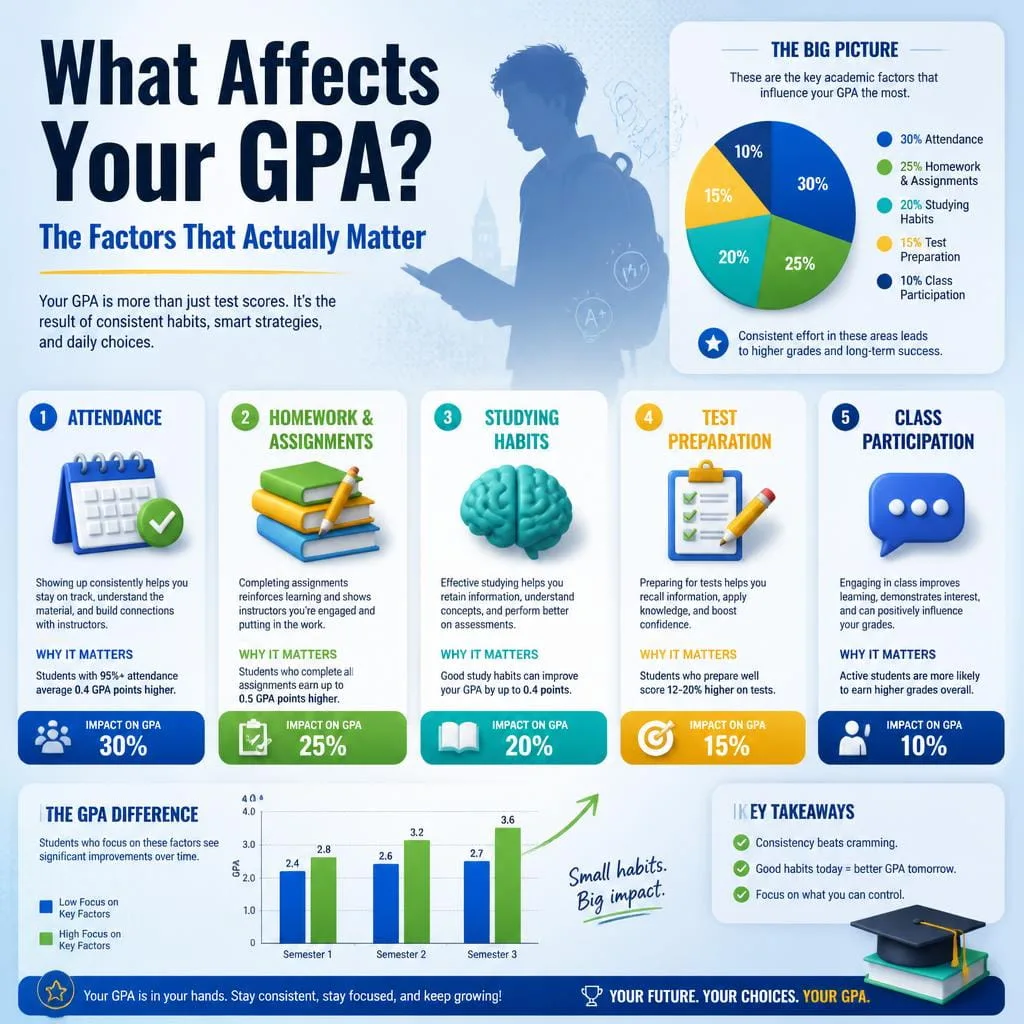
What Affects Your GPA? The Factors That Actually Matter
A clear, honest guide to understanding, protecting, and improving your Grade Point Average
Every student has heard the advice: “keep your GPA up.” But how many actually know what pushes it up, or drags it down? Your GPA does not move randomly. It responds to very specific decisions you make every semester.
This guide breaks down every major factor that affects your GPA, with honest context about which ones carry the most weight. No filler. No vague advice. Just the real mechanics behind the number on your transcript.
What Factors Have the Biggest Impact on GPA?
Not every element of student life hits your GPA equally. Some factors are structural, baked into the way GPA is calculated. Others are behavioral. Both matter.
1. Exam and Assignment Performance
This is the biggest one. Your GPA is a direct reflection of the grades you earn in each course. The final letter grade, whether it is an A, B, C, or worse, converts to grade points, which then feed into the weighted GPA formula.
According to the American Association of Collegiate Registrars and Admissions Officers (AACRAO), the 4.0 scale used by most U.S. universities assigns: A = 4.0, B = 3.0, C = 2.0, D = 1.0, and F = 0. Every exam, quiz, and project that builds toward your final grade in a course ultimately shapes your GPA.
Consistent performance across all assessments in a course matters far more than cramming for one final exam. Students who score well across multiple assessments tend to finish with stronger GPA outcomes than those who rely on a single high-stakes test.
2. Credit Hours and Course Weighting
This is the structural factor most students underestimate. GPA is a weighted average, not a simple average. A 4-credit course pulls your GPA harder than a 1-credit elective. That means failing or acing a heavy course moves the needle far more than you might expect.
The math is straightforward: multiply your grade points by the credit hours for each course, sum all those quality points, then divide by total credit hours attempted. A poor grade in a 4-credit course requires strong performance across several lighter courses just to compensate.
The practical takeaway: if you want to raise your GPA efficiently, focus your energy on high-credit courses. They move the number faster in both directions.
3. Course Difficulty and Grade Distribution
Not all courses are graded the same way. Science and engineering courses often have tighter grade distributions. A study published in PLOS ONE found that STEM courses tend to give lower average grades than humanities and social science courses at the same institutions. That reality affects the GPA of students who take heavier technical loads.
This does not mean you should avoid hard courses. It means you need realistic expectations when you sign up for them, and a study strategy that matches the difficulty.
How Much Does Attendance Influence GPA?
More than most students want to admit. Attendance does not appear as a line item on your transcript, but it quietly shapes your GPA through every grade you earn.
Research consistently supports this. A 2019 meta-analysis published in Frontiers in Psychology, covering over 7,000 students across multiple universities, found a statistically significant positive correlation between class attendance and academic performance. Students who attended regularly scored measurably higher on exams.
Why does showing up matter so much for your GPA?
• You absorb material in real time, reducing the gap between learning and testing.
• Professors often signal what matters for exams during lectures, not in textbooks.
• Some courses tie participation grades directly to attendance.
• Missing class compounds over the semester, each absence widens the knowledge gap.
One skipped lecture is rarely catastrophic. A habit of skipping? That will show up in your GPA whether you track it or not.
Can Missing Assignments Hurt My GPA?
Yes, and the math is ruthless. A zero on a missed assignment is not the same as a low score. It is a hard anchor that drags down your course average in ways that are very difficult to recover from.

Here is a simple illustration. If you score 90 on three assignments and miss one, your four-assignment average drops to 67.5, which is a D in most grading systems. No amount of effort on later work will fully erase that zero because it stays in the denominator.
Missing assignments hurt your GPA through two channels:
• Direct damage: the zero lowers your course grade, which lowers the grade points feeding into your GPA.
• Indirect damage: missed assignments often mean missed learning, which then shows up on exams.
If you have to miss something, contact your professor before the deadline. Many will grant extensions or partial credit, especially for students who communicate early. Saying nothing and turning in nothing is the worst outcome for your GPA.
How Do Extracurricular Activities Affect Your GPA?
The relationship between extracurriculars and GPA is genuinely complicated. It depends almost entirely on volume and how well a student manages their time.
Research from the National Survey of Student Engagement (NSSE) suggests that students involved in structured activities like clubs, sports, volunteer work, student government, report higher levels of academic engagement overall. Moderate involvement can actually help GPA by keeping students connected to campus and building disciplined schedules.
But there is a tipping point. When extracurricular commitments consume 20 or more hours per week, academic performance tends to decline. Student athletes, in particular, face documented challenges: a 2021 NCAA report found that Division I student athletes spent an average of 33 hours per week on sports-related activities during their season.
The honest version: one or two meaningful extracurricular commitments tend to support a healthy GPA. Six clubs, a part-time job, and a varsity sport simultaneously? Something will crack, and it is usually the academic side.
Extracurriculars do not appear on your GPA calculation. But they compete directly for the time and energy that feeds it.
Do Pass/Fail Courses Affect GPA?
In most cases, pass/fail courses do not affect your GPA at all. Most universities exclude P/F grades entirely from the GPA calculation. A passing grade does not add quality points, and a failing grade in a P/F course may or may not count, depending on your institution’s policies.
This is exactly why students sometimes take challenging electives on a pass/fail basis, it removes the GPA risk of a difficult subject while still allowing credit toward graduation requirements.
There are two important caveats:
• A P/F course will not boost your GPA either. If you excel in the subject, you lose that upside.
• Some programs and graduate schools look at P/F usage patterns. Excessive P/F credits in major courses can raise questions.
Always confirm your school’s specific policy before opting for pass/fail. Rules vary by institution and sometimes by department.
Other Factors That Quietly Affect Your GPA
Study Habits and Preparation Quality
How you study matters as much as how long you study. Research from cognitive science, including studies from Roediger and Karpicke at Washington University, consistently shows that retrieval practice (testing yourself, using flashcards, doing practice problems) produces significantly better retention than re-reading notes. Better retention means better exam scores, which means a better GPA.
Grade Replacement and Retake Policies
Many schools offer grade replacement: if you retake a course, the new grade replaces the old one in the GPA calculation. This is one of the most direct tools for GPA recovery. A C replaced by an A in a 3-credit course can meaningfully move your cumulative GPA over time. Always check your school’s specific policy, because some schools average both grades instead.
Academic Probation and GPA Minimums
Most universities set a minimum GPA threshold, typically 2.0, below which a student is placed on academic probation. Falling below this level puts scholarship eligibility, financial aid, and continued enrollment at risk. The U.S. Department of Education requires satisfactory academic progress standards for federal financial aid eligibility, which typically includes GPA requirements.
FAQs
Can one bad semester ruin my GPA?
It can seriously damage it, but ruin is too strong a word. Your cumulative GPA averages every semester. One bad semester hurts more early in your academic career, when you have fewer total credit hours to absorb the impact. Later semesters with stronger grades gradually dilute the damage, but the recovery takes time and consistent effort.
Does dropping a course affect your GPA?
If you drop a course before your school’s withdrawal deadline, it typically does not affect your GPA, it simply disappears from your record. Dropping after the deadline usually results in a W (withdrawal) on your transcript. A W does not factor into the GPA calculation but is visible to graduate schools and some employers. Multiple W grades can raise questions about follow-through.
Does work experience offset a low GPA?
Yes, especially after your first two to three years out of school. Employers in most industries weight relevant experience over GPA once you have a professional track record. A 2.9 GPA with two strong internships and a part-time job in your field is a competitive profile in many hiring contexts. The window where GPA dominates is roughly graduation to your mid-to-late 20s.
How often is my GPA updated?
Your GPA updates at the end of each grading period, typically after final grades are posted for the semester or quarter. Some schools update it on a rolling basis as final grades come in. Your semester GPA reflects that term only, while your cumulative GPA incorporates everything from your first course onward.
What GPA do most employers actually want?
It varies by industry. High-selectivity employers in finance, consulting, and engineering often apply a 3.5 screening threshold. Most employers across other industries use 3.0 as a soft floor. Below 3.0, some applications face automatic filtering in large recruiting systems. Above 3.5, GPA becomes largely a checkbox rather than a differentiator, other factors take over.
The Bottom Line
Your GPA is not a mystery. It responds predictably to specific inputs: how well you perform on assessments, how heavy your courses are, whether you show up, whether you submit your work, and how well you manage your time across everything else competing for your attention.
Understanding the mechanics gives you actual leverage. You can be strategic about which courses to take pass/fail, which ones to prioritize because of their credit weight, and when to reach out for an extension rather than accepting a zero.
GPA is a signal, not a sentence. Keep it healthy, understand what moves it, and build a profile that extends well beyond the number.