

What Is GPA?
The Highest Possible GPA and Why It Actually Matters for Your Future
You've heard it a hundred times, "keep your GPA up." But what does that actually mean? And is there such a thing as a perfect GPA? Let's break it all down clearly, honestly, and without the academic fluff.
What Is GPA?
GPA stands for Grade Point Average. It's a number that summarizes your academic performance over a semester, a year, or your entire academic career.
Schools calculate it by converting your letter grades (A, B, C, etc.) into numeric values, then averaging them across your courses. It's the academic world's version of a credit score, one number that tells a big story.
The most common grading scale used in the United States looks like this:
|
Letter Grade |
Grade Points |
|
A |
4.0 |
|
B |
3.0 |
|
C |
2.0 |
|
D |
1.0 |
|
F |
0.0 |
This is called the 4.0 scale, and it's the standard in most U.S. high schools, colleges, and universities. Many other countries use similar weighted systems, though the exact scales vary.
What Is the Highest Possible GPA You Can Get?
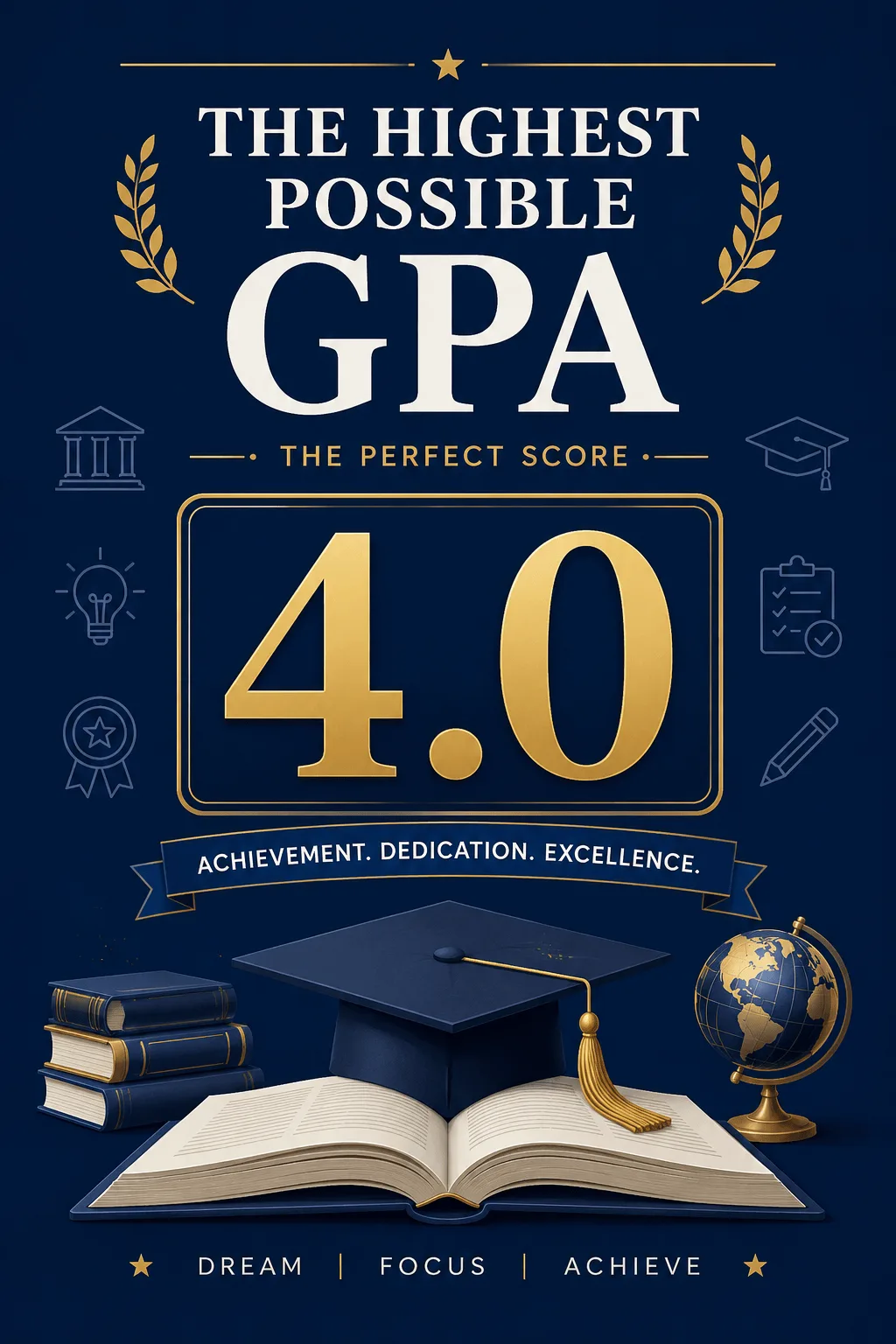
On a standard unweighted 4.0 scale, the highest GPA you can earn is 4.0. This means straight A's across every single class. No exceptions.
But here's where it gets interesting.
Many high schools now use a weighted GPA scale, which rewards students for taking harder courses, like AP (Advanced Placement), IB (International Baccalaureate), or honors classes. On a weighted scale, an A in an AP class is worth 5.0 instead of 4.0.
So technically, a student taking all AP or honors classes and earning straight A's could have a weighted GPA of 5.0 or higher. Some schools even go up to 6.0 on their own internal weighted systems.
However, colleges typically recalculate GPA on their own unweighted 4.0 scale during admissions, so that 5.3 you're proud of may land back at a 4.0 in their eyes.
How GPA Impacts Your Career and Future
Here's the real question most students have: does my GPA actually matter once I leave school? Honest answer, yes, but it depends on where you're headed.
Scholarships
This is where GPA has one of the most immediate, concrete impacts. According to the National Scholarship Providers Association, academic merit remains one of the top criteria for scholarship awards in the U.S.
Most merit-based scholarships require a minimum GPA, often 3.0 or higher. Competitive national scholarships, like the National Merit Scholarship, look for students who are clearly performing at the top of their class. A strong GPA doesn't just open doors, it can save you tens of thousands of dollars in student debt.
College and Graduate School Admissions
For college applicants, GPA is one of the primary factors admissions officers review. According to data from the National Association for College Admission Counseling (NACAC), grades in college-prep courses consistently rank as the top factor in admissions decisions at four-year institutions.
Graduate schools are even more GPA-focused. Medical schools, law schools, and MBA programs often have hard GPA cutoffs for applications. Many top programs look for a 3.5 or above just to be considered.
Jobs and Early Career
Right out of school, your GPA matters most in competitive fields. Investment banks, consulting firms, government agencies, and large corporations often screen candidates using GPA as an initial filter.
Goldman Sachs, McKinsey, and similar firms have historically preferred candidates with a GPA of 3.5 or above. The FBI requires applicants to have a minimum GPA depending on the field of expertise.
That said, once you have two to three years of real work experience, your GPA becomes much less relevant. Employers care more about what you've done than what grades you earned years ago.
Professional Licensing Exams
Some licensing exams, like the CPA exam (accounting) or bar exam (law), require candidates to have graduated from an accredited program with a satisfactory academic record. Your GPA during school can affect your eligibility to sit for these exams.
Strategies to Improve Your GPA and to get Highest Possible GPA
Good news: GPA is not fixed. You can always move it up with the right approach. Here are strategies that actually work.
1. Attend Every Class — Yes, Every Single One
It sounds obvious, but consistent attendance has a direct correlation with academic performance. A study published in the Journal of Educational Psychology found that class attendance was one of the strongest predictors of student grades. You can't learn what you miss.
2. Prioritize High-Credit Courses
Not all classes carry the same weight in your GPA calculation. A 4-credit course affects your GPA more than a 1-credit elective. Focus your time and energy on the courses that move the needle the most.
3. Seek Help Early — Not Right Before Finals
Most students wait until they're drowning to ask for help. Go to office hours. Use tutoring resources. Study groups work well when everyone is actually studying. The earlier you address a subject you're struggling with, the easier it is to recover your grade in that course.
4. Understand How Your School Weighs Grades
Some schools use plus/minus grading (A-, A, A+). A B+ can be worth 3.3 while an A- is 3.7. Knowing exactly where you stand in a course allows you to make smarter decisions about where to put your energy.
5. Retake Courses Where Possible
Many colleges allow grade replacement or forgiveness policies, meaning if you retake a course, the new grade replaces or averages with the old one. This is one of the most effective ways to recover a poor GPA. Check your school's specific policy before registering.
6. Take a Realistic Course Load
There's no prize for overloading your schedule. Taking five difficult courses at once and scraping C's hurts more than taking four and earning A's. Know your capacity and plan accordingly.
7. Use the First Two Weeks of Every Semester Strategically
The beginning of each semester carries enormous weight. Set up your study schedule, read syllabi, and identify which assignments are worth the most. Professors typically reveal their grading philosophy in the first week, pay attention.
Frequently Asked Questions About GPA
Is a 4.0 GPA really achievable?
Yes, plenty of students achieve it. But it requires consistent effort, good time management, and strategic course selection. It's not magic, but it's not easy either.
Does a high GPA guarantee success?
No. A 4.0 is a strong signal, but employers and schools also look at internships, research, leadership, communication skills, and real-world experience. Think of GPA as one strong piece of a larger puzzle.
What GPA do most employers look for?
For most entry-level jobs, a 3.0 or above is a safe benchmark. Competitive industries like finance, consulting, and law often prefer 3.5 or higher. Once you have work experience, GPA becomes far less important.
Can I recover a low GPA?
Yes. Focus on consistency over time, even a few strong semesters can meaningfully raise a cumulative GPA. Grade replacement policies and academic forgiveness programs at many colleges also help.
Is GPA calculated differently in high school vs. college?
Yes, though the core method is the same. High schools may use weighted scales more commonly for honors and AP classes. Colleges typically report both weighted and unweighted GPA. Graduate programs almost always focus on your college GPA, not your high school record.
Does GPA matter more in some countries than others?
In the United States, Canada, and Australia, GPA is a standard, widely-used metric. In the UK, academic performance is typically measured through degree classifications (First, 2:1, 2:2, etc.) rather than a numeric GPA. International students applying to U.S. graduate schools often have their transcripts converted by services like WES (World Education Services).
Final Thoughts
GPA is a tool, not a verdict on your intelligence or your future. A 4.0 is impressive. A 3.2 with strong internships and leadership experience is also impressive. What matters is that you understand the system, play it strategically, and stay consistent.
The highest possible GPA on a standard unweighted scale is a 4.0. On a weighted scale, it can go higher. But the real goal isn't a perfect number, it's building the skills and habits that make you genuinely good at what you do.