
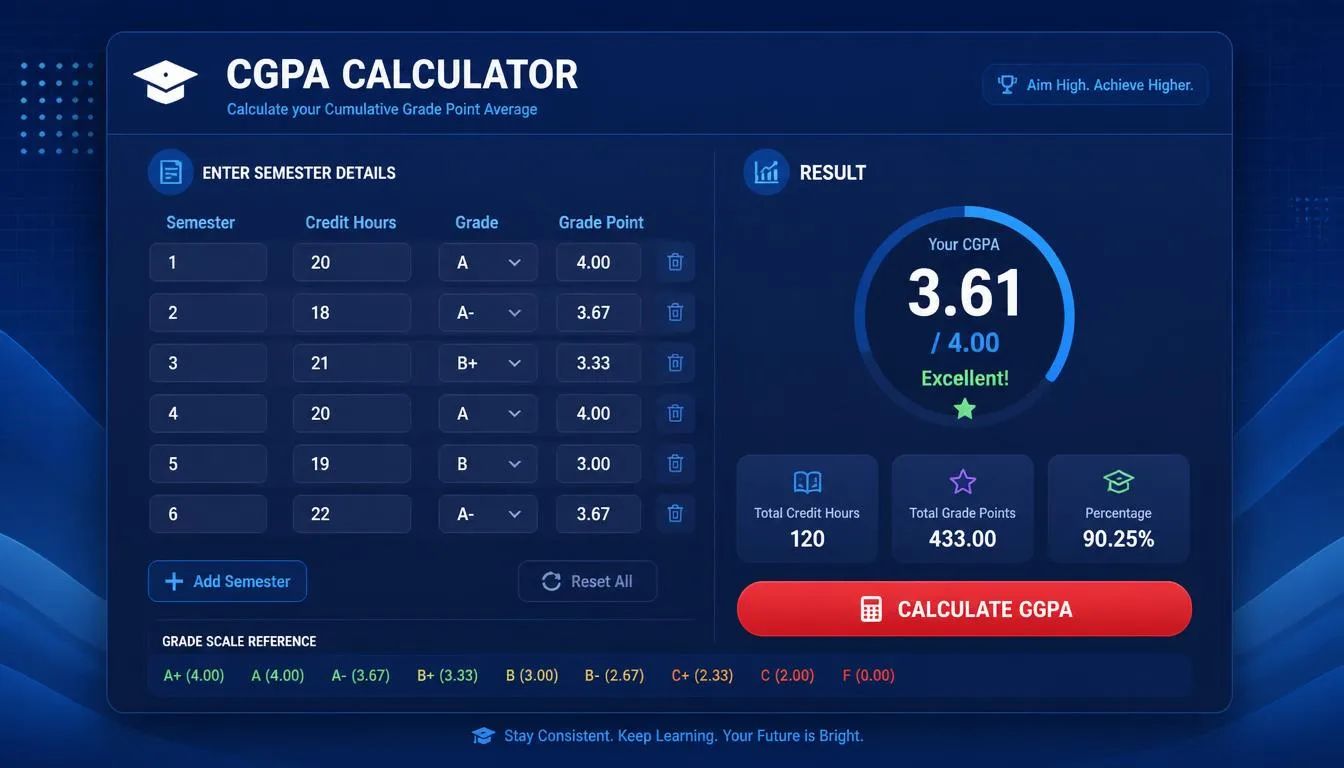
CGPA Calculator: What It Is, How It Works, and How to Improve Your Score
A complete, honest guide to understanding your CGPA — how to calculate it manually, what affects it, and practical strategies to push it higher.
Ask any university student what their CGPA is, and you will get one of two reactions: quiet confidence or immediate subject change. That four-point number carries enormous weight, and yet most students have only a vague idea of how it actually gets calculated.
This guide changes that. Whether you want to calculate your CGPA manually, understand how a CGPA calculator works, or find genuine strategies to improve your score, you will find clear answers here, backed by real sources, not academic guesswork.
What Is a CGPA Calculator?
A CGPA calculator is a digital tool that computes your Cumulative Grade Point Average across multiple semesters or an entire academic programme. It takes your individual course grades, applies credit hour weightings, and produces a single cumulative figure that represents your overall academic performance.
CGPA stands for Cumulative Grade Point Average. The word "cumulative" is the key distinction, it does not just measure one semester. It tracks your performance across every semester you have completed, rolling them all into one continuously updated number.
Most CGPA calculators ask you to input:
• The grade or grade point you earned in each course
• The credit hours assigned to each course
• The number of semesters you want to include
The calculator then applies a weighted average formula and outputs your CGPA on a standard scale, most commonly 4.0 in the United States, 10.0 in many South Asian universities, or a percentage-based system in others.
According to the American Association of Collegiate Registrars and Admissions Officers (AACRAO), GPA and CGPA remain the most universally used academic performance metrics across higher education institutions globally.
Online CGPA Calculators: What Makes a Good One?
A reliable CGPA calculator should allow you to:
• Add multiple courses per semester with individual credit hours
• Include previous semester results for cumulative calculation
• Switch between grading scales (4.0, 5.0, 10.0)
• Show a semester-by-semester GPA breakdown alongside the cumulative figure
Tools built into university portals — like Canvas, Blackboard, and Banner, handle this automatically. For manual verification, platforms like Calculator.net and RapidTables offer free, accurate CGPA calculators that work across multiple grading systems.
How Does a CGPA Calculator Work?
The mechanics behind a CGPA calculator are straightforward once you understand the core concept: it is a weighted average, not a simple average. Credit hours are the weights. Grade points are the values.
Here is the logic in plain terms:
A course worth four credit hours contributes more to your CGPA than a course worth two credit hours, even if you earn the same grade in both. The calculator multiplies your grade point by the credit hours for each course, adds all those products together, then divides by the total credit hours attempted.
This ensures that major, intensive subjects carry proportionally more influence on your CGPA than lighter elective courses. That is fair, logical, and exactly how most universities worldwide structure their grading systems.
Grade Point Scale: The Foundation of the Calculation
Before any calculation happens, grades convert to grade points. On the standard US 4.0 scale:
• A / A+ = 4.0
• A- = 3.7
• B+ = 3.3
• B = 3.0
• B- = 2.7
• C+ = 2.3
• C = 2.0
• D = 1.0
• F = 0.0
On a 10.0 scale, used widely in Indian universities and several other South Asian systems, grades typically convert on a 1–10 range, with 10 representing the highest outstanding performance and grades below 4 or 5 generally indicating failure.
How to Calculate CGPA Manually — Step by Step
You do not need a calculator app to work out your CGPA. A notebook, a pen, and this guide are enough. Here is the full manual method.
Step 1: List Every Course and Its Credit Hours
Write down every course you have taken, organised by semester. Next to each course, note the credit hours assigned to it. Your university transcript or course catalogue lists these.
Example — Semester 1:
• Mathematics — 3 credit hours
• English Composition — 3 credit hours
• Introduction to Computer Science — 4 credit hours
• Physics — 4 credit hours
• History — 2 credit hours
Step 2: Record Your Grade Point for Each Course
Convert each letter grade to its grade point equivalent using your institution's official scale. Using the 4.0 scale:
• Mathematics — B+ = 3.3
• English Composition — A = 4.0
• Introduction to Computer Science — A- = 3.7
• Physics — B = 3.0
• History — A = 4.0
Step 3: Multiply Grade Points by Credit Hours
This gives you the "quality points" for each course:
• Mathematics: 3.3 × 3 = 9.9
• English Composition: 4.0 × 3 = 12.0
• Intro to CS: 3.7 × 4 = 14.8
• Physics: 3.0 × 4 = 12.0
• History: 4.0 × 2 = 8.0
Step 4: Add All Quality Points Together
9.9 + 12.0 + 14.8 + 12.0 + 8.0 = 56.7 total quality points
Step 5: Add All Credit Hours Together
3 + 3 + 4 + 4 + 2 = 16 total credit hours
Step 6: Divide Total Quality Points by Total Credit Hours
56.7 ÷ 16 = 3.54 GPA for Semester 1
Step 7: Repeat for Each Semester, Then Calculate Cumulative
To get your CGPA, add the total quality points across all semesters and divide by the total credit hours across all semesters. Do not average the semester GPAs — always go back to the raw quality points and credit hours for accuracy.
Example across two semesters:
• Semester 1: 56.7 quality points, 16 credit hours
• Semester 2: 61.2 quality points, 18 credit hours
CGPA = (56.7 + 61.2) / (16 + 18) = 117.9 / 34 = 3.47
Your CGPA after two semesters is 3.47. That is a solid B+ average, competitive for most graduate school applications and well above the 3.0 threshold most merit scholarships require.
Strategies to Improve Your CGPA
A low CGPA is not a life sentence. The cumulative nature of the system actually works in your favour over time, strong performance in later semesters meaningfully lifts your overall score. Here are proven, research-backed strategies to make that happen.

1. Prioritise High-Credit-Hour Courses
Not all courses affect your CGPA equally. A four-credit course has twice the impact of a two-credit course. Identify your highest-credit subjects each semester and allocate proportionally more study time to them. A grade jump from B to A in a four-credit course improves your CGPA more than the same jump in a two-credit elective.
2. Use Spaced Repetition for Exam Preparation
A 2019 study published in Psychological Science confirmed that spaced repetition, reviewing material at increasing intervals over time, improves long-term retention by approximately 20% compared to massed cramming sessions.
Apps like Anki implement spaced repetition automatically. Students who build this habit in their first semester consistently report better exam performance with less last-minute panic by their second year.
3. Attend Every Class — Seriously
A comprehensive meta-analysis published in the Review of Educational Research analysed 69 independent studies and found a strong, consistent positive correlation between class attendance and final grades. Students attending over 90% of sessions outperformed lower-attendance peers significantly, even after controlling for prior academic ability.
Every missed lecture is a knowledge gap that costs time to fill independently, and time is your scarcest academic resource.
4. Take Advantage of Grade Replacement Policies
Many universities allow students to retake courses in which they performed poorly, replacing the original grade with the new one in the CGPA calculation. This policy, sometimes called academic forgiveness or grade substitution, can meaningfully lift a damaged CGPA. Check your institution's academic regulations to see whether this option applies to you.
5. Seek Academic Support Early, Not Late
Most students visit tutoring centres or academic advisors only after results disappoint. Research from the National College Learning Center Association shows that students who access academic support services proactively, before midterms, improve their final grades by an average of half a letter grade compared to those who seek help reactively.
Office hours, peer tutoring, writing centres, and faculty feedback sessions are free resources that most universities provide. Use them before you need them desperately.
6. Manage Workload Strategically by Semester
Overloading your semester with difficult courses simultaneously is one of the most common self-inflicted CGPA injuries. If your programme allows elective scheduling flexibility, balance demanding core subjects with lighter electives each semester. A consistent 3.5 across six manageable semesters beats a 4.0 followed by a 2.3 crash every time.
7. Build Consistent Sleep and Study Routines
Harvard Medical School research demonstrates clearly that sleep deprivation impairs memory consolidation, the neurological process that converts short-term learning into long-term retention. Students who sleep fewer than six hours regularly perform measurably worse on assessments than those meeting the recommended seven to nine hours.
Build your study schedule around your sleep schedule, not the other way around.
Frequently Asked Questions (FAQs)
Q1: What is considered a good CGPA?
On a 4.0 scale, a CGPA of 3.5 and above is generally considered excellent and competitive for graduate school applications and top-tier employer screening. A CGPA between 3.0 and 3.49 is solid and meets most scholarship and programme progression requirements. Below 2.0 typically triggers academic probation at most universities.
Q2: Does CGPA reset every semester?
No. That is the defining feature of a cumulative GPA. Your CGPA carries all previous semester results forward and updates with each new semester's performance. Your semester GPA resets each term, but your CGPA never does, which is why early semesters matter more than students often realise.
Q3: Can I calculate CGPA on a 10.0 scale manually?
Yes, the method is identical. Instead of converting grades to a 4.0 scale, you use your institution's 10-point grade conversion table. Multiply each course's grade point (out of 10) by its credit hours, sum all products, and divide by total credit hours. The formula does not change, only the scale does.
Q4: How much can my CGPA realistically improve in one semester?
That depends on how many credit hours you have already accumulated. Early in your degree, one strong semester can shift your CGPA by 0.3 to 0.5 points. Later in your degree, with more cumulative credit hours, the same semester performance produces a smaller shift, perhaps 0.1 to 0.2 points. The earlier you act, the greater the impact.
Q5: Do employers care about CGPA?
For entry-level positions, yes, particularly in competitive sectors like finance, consulting, law, and engineering. A 2023 NACE survey found that 68% of employers set a minimum GPA threshold for initial candidate screening. After five or more years of professional experience, fewer than 15% of employers consider academic grades in hiring decisions. Grades open the first door. What you do after that keeps it open.
A Personal Opinion: Your CGPA Is a Tool, Not a Verdict
Here is something worth saying directly: the obsession with CGPA in many academic cultures has gone too far, and not nearly far enough in others. Both extremes cause harm.
Students who dismiss their CGPA entirely, treating grades as irrelevant metrics invented by bureaucrats, often discover too late that a 2.4 closes more doors than they expected. Students who define their entire self-worth by a 3.9 GPA often arrive at graduation burned out, anxious, and unsure what to do with themselves when no one is handing out grades anymore.
The healthiest relationship with your CGPA is a strategic one. Know what it is. Know how it is calculated, and this guide has shown you exactly that. Know the floor you need to maintain for your specific goals. And then pursue the underlying learning with genuine curiosity, because the knowledge you actually retain is the asset that compounds across a career. The CGPA is the receipt. The knowledge is the purchase.
Use a CGPA calculator as a planning tool, not a self-assessment tool. It tells you where you stand mathematically. It says nothing about where you are going.
Final Thoughts
A CGPA calculator is more than a convenience, it is a planning instrument that gives you real-time visibility into your academic standing. Understanding how it works, and how to calculate your CGPA manually, puts you in control of a number that carries real consequences for scholarships, graduate admissions, and early career opportunities.
The strategies in this guide, prioritising high-credit courses, studying with spaced repetition, attending consistently, managing workload smartly, and protecting your sleep. are not quick fixes. They are compounding habits. Start one this week. Your future CGPA will reflect it.
Calculate it. Understand it. Improve it. But never let it define you.