

CGPA: What Success and Failure Actually Do
A Practical Guide for Students
How CGPA Works
CGPA (Cumulative Grade Point Average) is a weighted average. Every course counts based on its credit hours. A 3-credit course affects your CGPA three times as much as a 1-credit course.
The formula:
CGPA = Total Grade Points Earned / Total Credit Hours Attempted
Grade points come from your letter grade. On a 4.0 scale, A = 4.0, B = 3.0, C = 2.0, D = 1.0, F = 0.0. Every semester updates this number cumulatively.
What Happens to CGPA After a Success
A strong grade pulls your CGPA up, but the effect depends on 2 things: the grade itself and the credit weight of the course.
RULE High-credit courses move your CGPA more than low-credit ones. An A in a 4-credit course matters more than an A in a 1-credit elective.
Factors that determine the size of the boost
• Your current CGPA. The lower your starting point, the more a strong grade moves the needle.
• Total credits completed so far. Early in your degree, each course has more weight. By year 3, a single A has less impact because your history is longer.
• The grade earned. An A (4.0) gives maximum grade points. A B+ (3.3) still helps but less.
EXAMPLE You have a 2.5 CGPA over 60 credits. You earn an A (4.0) in a 3-credit course. Your new CGPA rises to roughly 2.56. Small, but it compounds.
One good semester is not enough
Students often expect dramatic recovery after one strong semester. The math works against you when your credit history is long. Consistent performance over multiple semesters is what moves CGPA meaningfully.
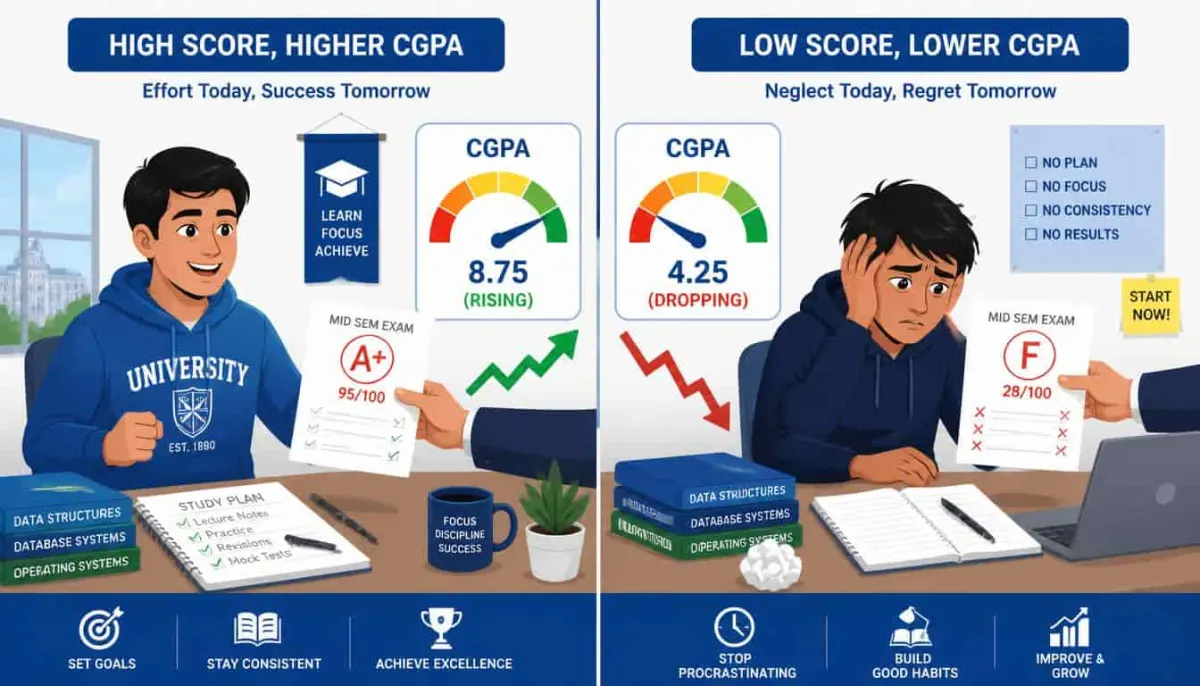
What Happens to CGPA After a Failure
An F gives 0 grade points. It drags your CGPA down sharply and adds to your attempted credits, making recovery harder.
EXAMPLE You have a 3.2 CGPA over 45 credits. You fail a 3-credit course (0 grade points). Your CGPA drops to roughly 3.12. Recover that: you need roughly a 4.0 in 5 equivalent credit hours just to return to 3.2.
The repeat problem
Most universities allow course repeats. When you retake a failed course, the new grade replaces the F in CGPA calculations at many institutions, but the original F may still appear on your transcript. Check your specific institution's repeat policy before assuming it wipes the record.
What a failure costs you beyond CGPA
• Time: you lose the semester's effort and must spend more time and money to retake the course.
• Sequence: many courses are prerequisites. Failing one can delay graduation by a full semester or year.
• Financial aid: many scholarships and aid packages require a minimum CGPA. Falling below the threshold may put funding at risk.
• Probation: universities typically place students on academic probation if CGPA drops below 2.0. A second consecutive poor semester can result in suspension.
Surviving a Failure: How to Get Good Grades
One failure does not end an academic career. Students have recovered from multiple Fs and graduated with honors. The path is systematic, not motivational.
Step-by-step recovery plan
1. Understand exactly where you stand.
Pull your full transcript. Calculate your current CGPA manually. Identify which courses dragged it down and what credit weight they carry. You need precise numbers, not a vague sense of being behind.
2. Talk to your academic advisor immediately.
Do this before the next semester's registration. Advisors can flag retake options, load adjustments, and deadlines you may not know about. Many students avoid this conversation out of embarrassment. Do it anyway.
3. Reduce your course load if necessary.
Taking 6 courses and passing 4 is worse than taking 4 and passing all 4. A targeted, lighter load with stronger grades recovers CGPA faster than overloading and getting Cs.
4. Retake your highest-credit failed courses first.
If you failed a 4-credit course and a 1-credit course, the 4-credit retake does 4 times more CGPA work. Prioritize by credit weight.
5. Build a study system, not a study intention.
Set fixed study blocks in your calendar for each course. Review lecture notes within 24 hours. Do practice problems before the exam week. These are habits with measurable outcomes, not motivation-dependent plans.
6. Use office hours.
Most students never go. Professors remember the ones who do. Office hours clarify confusion early, before it compounds into a failed exam. One 20-minute session can fix a misunderstanding that costs 10 points.
7. Form a study group, with the right people.
Study groups work when members are serious. One distracted member can waste an hour. Pick 2 or 3 people who prepare before the session, not during it.
8. Track every grade as you go.
Calculate your running grade in each course after every assignment. If you know you need a 78 on the final to pass, that is a specific target. Vague worry helps nothing. Specific numbers do.
9. Protect your sleep and your health.
Students who consistently sleep under 6 hours perform worse on recall and problem-solving tasks. All-nighters before exams typically hurt more than they help. The research on this is consistent.
10. Give it more than one semester.
Recovery takes time because CGPA is cumulative. Set a 2-semester plan with realistic targets. A 0.3 CGPA improvement in 2 semesters is a genuine win, not a failure.
Effects of bad grades on HEC scholarships
HEC scholarships require a minimum CGPA, typically 2.5 for need-based and 3.0 or above for merit-based programs. Falling below the threshold triggers consequences at different stages.
Suspension of funding HEC reviews CGPA at the end of each semester. If you drop below the required minimum, scholarship payments stop until you restore your grade to the required level.
Probationary period Some programs give one semester's grace. You get a warning and a single chance to recover. A second consecutive semester below the cutoff usually ends the scholarship permanently.
Full cancellation Merit scholarships like HEC Need-Based Scholarship and Indigenous Scholarship have strict continuation criteria. Once cancelled for poor performance, reinstatement is rare and requires a formal appeal with supporting documentation.
Degree completion risk HEC scholarships are tied to timely degree completion. Failing courses extends your degree timeline. If you exceed the maximum allowed duration, funding stops regardless of your current CGPA.
Repayment clauses Certain HEC programs include repayment conditions. If you fail to meet academic requirements or withdraw, you may owe back some or all of the disbursed amount.
The safest position: stay at least 0.3 points above the minimum at all times. A single difficult semester can push you below the cutoff faster than one good semester can pull you back up.
Frequently Asked Questions
Q: If I retake a failed course and pass, does the F disappear?
A: At most institutions, the new grade replaces the F in your GPA calculation, but the original F stays visible on your transcript. Some universities average both grades instead. Check your institution's specific repeat policy.
Q: Can I recover from a 1.8 CGPA?
A: Yes, but it requires time and sustained performance. If you have 60 credits at 1.8, you need roughly 60 more credit hours averaging 3.0 just to reach a 2.4. That is doable in 2 years of consistent work. The earlier you start, the better.
Q: Does a W (withdrawal) hurt my CGPA?
A: A W typically does not affect GPA calculation at all. It adds to attempted credits at some institutions but gives no grade points. Withdrawing before a likely F is often the smarter choice. Confirm the deadline with your registrar.
Q: How many credits does it take to raise CGPA by 0.1?
A: It depends on your current base. With 60 credits of history, raising CGPA by 0.1 takes roughly 15 credit hours all at A-level, or more if grades are mixed. With 30 credits of history, the same 15 credit hours at A-level raises it by about 0.2.
Q: Should I take easier courses to boost my CGPA?
A: Strategically, yes, some students take lighter electives to build their GPA. But do not sacrifice major-required courses or delay graduation to do it. The best approach is to take required courses seriously and use electives wisely.
Q: Does CGPA matter for jobs?
A: For some fields and some employers, yes. Finance, consulting, and some government positions screen by GPA cutoffs, often 3.0 or 3.5. In many technical fields, project experience and skills outweigh GPA past a minimum threshold. Research the hiring norms in your target field.
A Student Mentor's Perspective
I've seen students spiral after one bad semester because they treated a grade as a verdict on their ability. It isn't. It's information. Something went wrong: time management, a difficult course load, a personal crisis, unclear study habits. The question worth asking is which one, not how badly you failed.
The students who recover well share a few things. They don't wait. They talk to their advisor in the first week after grades drop, not after they've avoided it for two months. They make a concrete plan with numbers. Not 'I'll study harder.' Something like: 'I'll get at least a 3.2 in all 4 of these courses this semester and retake the one I failed.'
They also stop comparing. CGPA comparisons with peers are mostly useless. Someone else's 3.7 across an easy load tells you nothing about your 3.1 across a harder one. The comparison that matters is: am I performing better than I did last semester?
A few things I tell students directly:
• One failure does not define a transcript. Three consecutive semesters of improvement do.
• The students who vanish from the registrar's office tend to stay stuck. Show up.
• Your degree is long enough to recover from almost anything if you start now.
• Sleep, food, and mental health are not luxuries. They're inputs. When those break down, grades follow.
If you're reading this after a difficult semester, that's a reasonable place to be. The work is to diagnose what went wrong and fix the specific thing, not to feel worse about it. That's a productive use of the next 4 months.