

How Final Grades Are Calculated: Everything Students Need to Know
A clear, no-fluff guide to understanding final grade calculations, the strategies top students use, and honest answers to your most common questions.
Every student has been there. You sit down, stare at your syllabus, and wonder: "Wait, how does my professor actually turn all these assignments into one final grade?" You are not alone. In fact, you are in very good company.
Final grades determine scholarships, academic standing, college admissions, and in some cases, your confidence for the next semester. Understanding how they work is not just useful, it is essential.
This guide breaks down final grades calculations clearly and honestly. No fluff, no fake data, just the real mechanics behind the numbers.
What Is Meant by Final Grades?
A final grade is the official mark a student receives at the end of a course. It represents the overall academic performance across the entire term. not just the last exam.
According to the National Center for Education Statistics (NCES), grading systems in the United States typically use letter grades (A through F), percentage scores, or Grade Point Averages (GPA) on a 0–4.0 scale.
Here is what final grades typically represent:
· A (90–100%) — Excellent understanding of course material
· B (80–89%) — Above average performance
· C (70–79%) — Satisfactory, meets minimum expectations
· D (60–69%) — Below average, but still passing in most systems
· F (Below 60%) — Failing grade
Different institutions may use slight variations. Some schools use a +/- system (A+, A, A-, B+, etc.), which affects GPA calculations more granularly.
How Final Grades Are Calculated
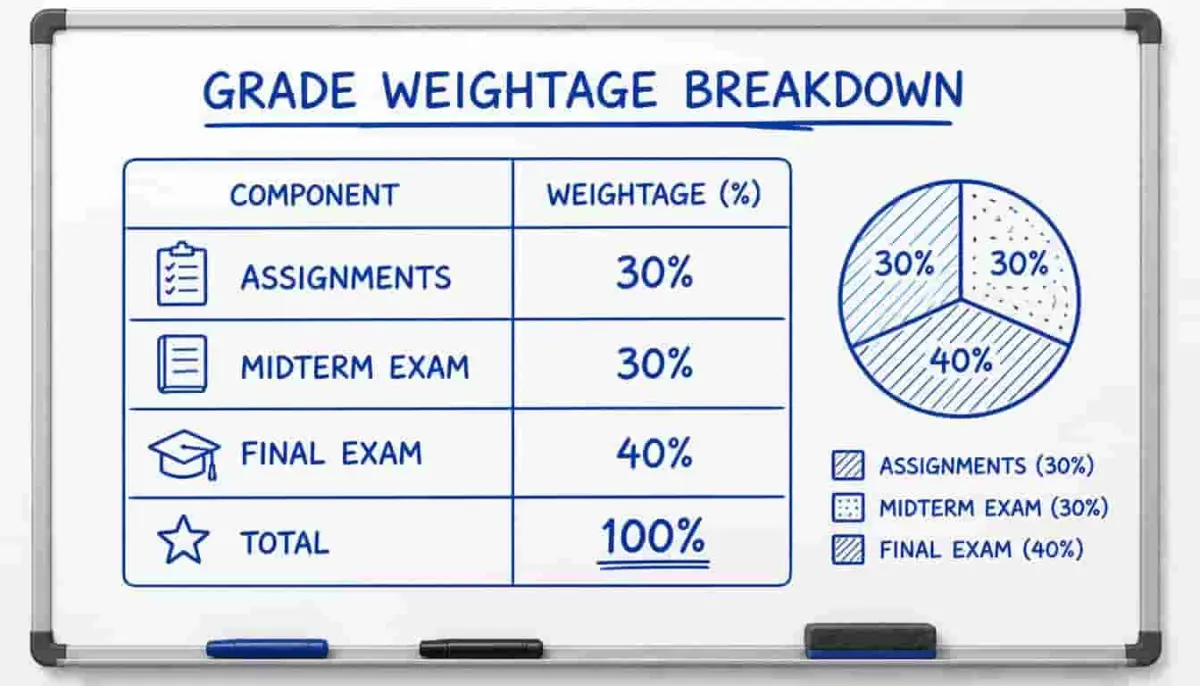
This is where it gets interesting and honestly, where most students get confused. Final grades are not just your last exam score. They are a weighted combination of everything you did in the course.
The Weighted Average Method for calculating Final Grades
Most courses use a weighted average system. Each category of work (quizzes, assignments, midterms, finals) carries a specific percentage of the total grade.
Here is a simple example:
· Assignments: 30%
· Midterm Exam: 25%
· Final Exam: 35%
· Participation: 10%
If you scored 80% on assignments, 75% on the midterm, 85% on the final, and 90% on participation, your final gradeS calculates like this:
(80 × 0.30) + (75 × 0.25) + (85 × 0.35) + (90 × 0.10) = 24 + 18.75 + 29.75 + 9 = 81.5%
That gives you a B. Not bad, and now you know exactly why.
Points-Based System
Some instructors use a points system instead. Every assignment has a point value, and your final grade is your total points divided by the total possible points.
For example, if a course has 500 total points and you earned 435, your grade is 435 ÷ 500 = 87% , a solid B+.
Straight Average Method
Occasionally, a professor uses a simple straight average, add all your scores together and divide by the number of scores. This is less common at the university level but still appears in some high school settings.
Pass/Fail or Credit/No Credit
Some courses offer a pass/fail option. Students typically need to score above a threshold (often 60–70%) to pass. The grade does not affect GPA directly in most systems, but failing can still impact academic standing.
Many universities publish their specific grading policies in their academic catalog or registrar's office website. Always check your institution's official documentation.
Methods to Calculate Final Grades — A Closer Look
Let us go a little deeper. Different systems handle final grade calculations differently, and knowing which one your school uses puts you ahead of the curve.
In the United States, the GPA system is standard at most colleges and universities. According to the College Board, a 4.0 GPA scale is the most widely used format:
· A = 4.0
· B = 3.0
· C = 2.0
· D = 1.0
· F = 0.0
To calculate your semester GPA, multiply the grade points for each course by its credit hours. Add all those together, then divide by the total credit hours taken.
Example: You take three courses, English (3 credits, A = 4.0), Math (4 credits, B = 3.0), and History (3 credits, A- = 3.7).
(4.0 × 3) + (3.0 × 4) + (3.7 × 3) = 12 + 12 + 11.1 = 35.1 ÷ 10 total credits = 3.51 GPA
Cumulative vs. Semester GPA
Your semester GPA covers just one term. Your cumulative GPA covers all completed semesters. Employers and graduate schools typically look at cumulative GPA, so one tough semester does not ruin everything.
Curve Grading
Some professors adjust grades upward when the class average falls below expectations. This is called curving. If the class average on a midterm was 58%, the professor might add 12 points to everyone's score to shift the average to 70%.
Curves are never guaranteed. Do not plan your semester around hoping for one.
Standards-Based Grading
A growing number of schools, particularly at the K–12 level, use standards-based grading (SBG). Instead of averaging scores, SBG evaluates whether a student has mastered specific learning targets.
Research from the Association for Supervision and Curriculum Development (ASCD) suggests SBG can give a more accurate picture of student mastery compared to traditional averaging.
How Some Students Get Good Grades — Proven Strategies
Here is the honest truth: top-performing students are not always the smartest people in the room. They are usually the most strategic. Here is what they do differently.
1. They Read the Syllabus Like a Contract
Every weight, every deadline, every policy lives in the syllabus. High achievers treat it like a roadmap, because it is one. They know exactly how much each assignment is worth before they even start.
2. They Focus on High-Weight Categories First
If your final exam is worth 40% of your grade, it deserves 40% of your study time, at minimum. Spending equal energy on a 5% quiz and a 40% final exam is one of the most common and costly mistakes students make.
3. They Track Their Grade in Real Time
Waiting until the end of the semester to check your grade is like waiting until the last mile of a road trip to check if you have gas. Tools like MyGrade.com or even a simple spreadsheet let you monitor your standing continuously.
4. They Attend Office Hours — Seriously
A 2019 study published in Learning and Instruction found that students who regularly visited instructor office hours performed significantly better on exams than those who did not. Professors remember the students who show effort.
5. They Practice Spaced Repetition
Cramming is for people who enjoy suffering. Spaced repetition, reviewing material at increasing intervals, is backed by decades of cognitive science research. The Learning Scientists (learningscientists.org) summarize this and five other evidence-based strategies freely online.
6. They Take Care of Their Sleep
The American Academy of Sleep Medicine recommends 8–10 hours of sleep for teenagers and 7–9 hours for adults. Sleep consolidates memory. Pulling an all-nighter before an exam actively hurts your performance. The research on this is overwhelming and consistent.
7. They Ask for Grade Breakdowns Early
If you are struggling in week 6, you still have time to recover. Students who ask their professors or advisors "What do I need to score on the final to get a B?" can target their effort precisely rather than panic broadly.
Frequently Asked Questions About Final Grades
Q: Can one bad grade ruin my final grade?
It depends on the weight. A 5% quiz? Barely a dent. A 40% final exam? That one matters a lot. Calculate the impact before you panic.
Q: What is a passing final grade?
Most US high schools require a 60–65% (D) to pass. Colleges often require a C (70–73%) or higher in core courses. Graduate programs typically require a B (80%+) to maintain good standing. Always check your institution's specific policy.
Q: Does attendance affect my final grade?
Only if your syllabus says it does. Some courses include participation or attendance as a graded component (often 5–15%). Others do not grade it formally but will affect your understanding of material, which indirectly affects everything else.
Q: Can I negotiate my final grade with a professor?
Asking politely, and with evidence, is always reasonable. Demanding a grade change without basis is not. Professors can correct genuine errors in grading. They are not, however, required to adjust grades because the semester was hard.
Q: How does an incomplete (I) grade affect GPA?
An incomplete grade is a temporary status. If the student completes outstanding work within the allowed time (typically one semester), the final grade replaces the I. Until then, it usually counts as an F for GPA purposes at most institutions.
Q: What is the difference between a weighted and unweighted GPA?
An unweighted GPA treats all courses equally on a 4.0 scale. A weighted GPA gives extra points (often 0.5 or 1.0) for honors, AP, or IB courses. Many colleges recalculate GPAs on their own scale during admissions, so both matter.
Personal Opinion: What Grades Actually Tell You
Here is an honest take: grades are a useful signal, not a full picture of a person.
A 4.0 GPA does not guarantee success in life. A 2.8 GPA does not disqualify you from it. What grades do measure, reasonably well, is your ability to understand expectations, manage time, and deliver results under specific conditions. Those are actually valuable real-world skills.
The students who obsess only over the number often miss the point. The ones who chase genuine understanding, ask hard questions, and engage with material deeply tend to earn better grades anyway, because learning and good grades are not as separate as students sometimes think.
If your grades are not where you want them, that is useful information. It tells you something needs to change, the strategy, the study habits, the resources you are using, or sometimes the major itself.
Grades matter. But they are a tool, not a verdict.