
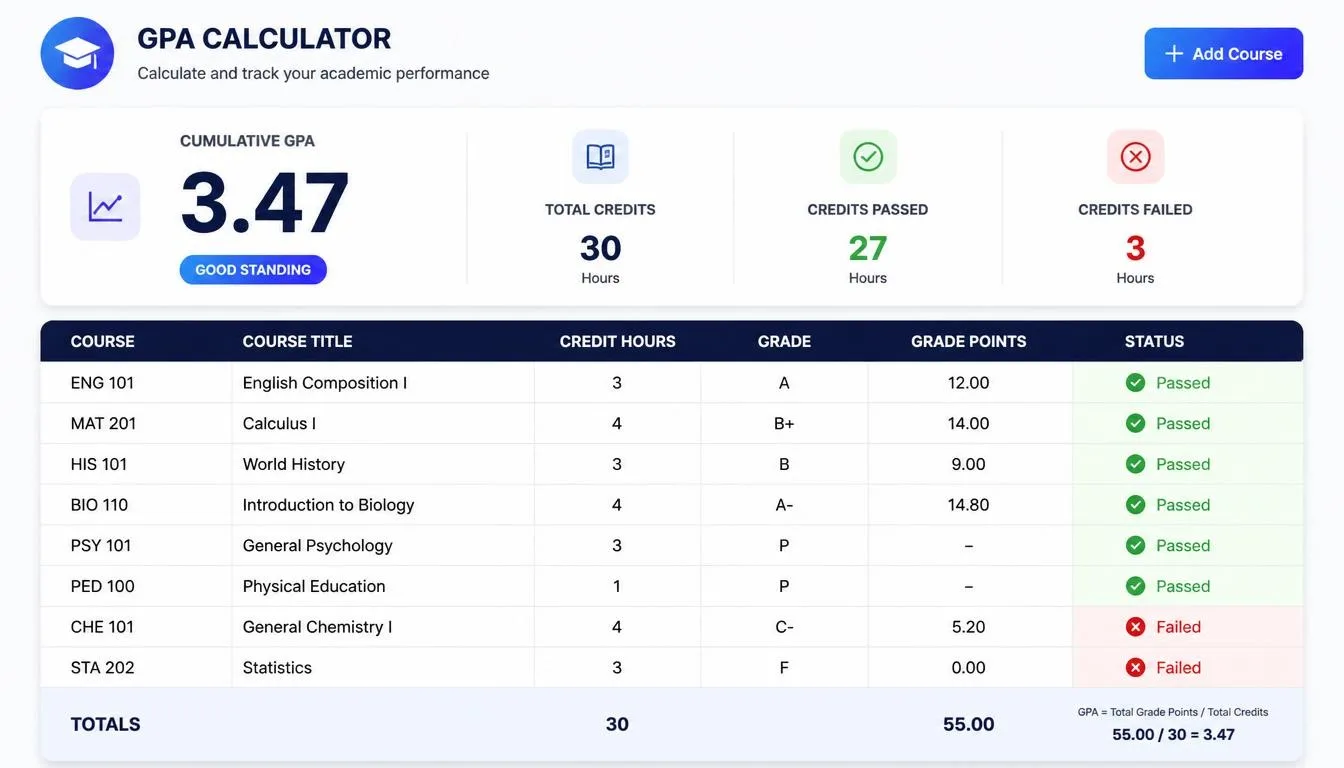
GPA Calculator with Pass/Fail Classes
Your complete guide to understanding, calculating, and improving your GPA
What Is GPA?
GPA stands for Grade Point Average. It is a number that summarizes your academic performance across all your courses. Schools, employers, and graduate programs use GPA as a quick way to compare students.
Most U.S. schools use a 4.0 scale. On that scale, an A equals 4.0 points, a B equals 3.0, a C equals 2.0, and so on down to an F at 0.0. Your GPA is the weighted average of all those point values, with each course weighted by its credit hours.
A cumulative GPA covers every course you have taken. A semester GPA covers only one term. Graduate schools look at both, but cumulative GPA carries more weight.
Grade point reference
|
Letter Grade |
Grade Points |
Percentage |
|
A+ |
4.0 |
97-100% |
|
A |
4.0 |
93-96% |
|
A- |
3.7 |
90-92% |
|
B+ |
3.3 |
87-89% |
|
B |
3.0 |
83-86% |
|
B- |
2.7 |
80-82% |
|
C+ |
2.3 |
77-79% |
|
C |
2.0 |
73-76% |
|
C- |
1.7 |
70-72% |
|
D |
1.0 |
60-69% |
|
F |
0.0 |
Below 60% |
|
P (Pass) |
N/A |
Usually 70%+ |
|
F (Fail) |
0.0* |
Below passing |
* Whether a Fail in a pass/fail course counts as 0.0 in your GPA depends on your school's policy. Most schools exclude both Pass and Fail from the GPA calculation; some include only the Fail. Confirm with your registrar.
How to Calculate GPA: Step-by-Step
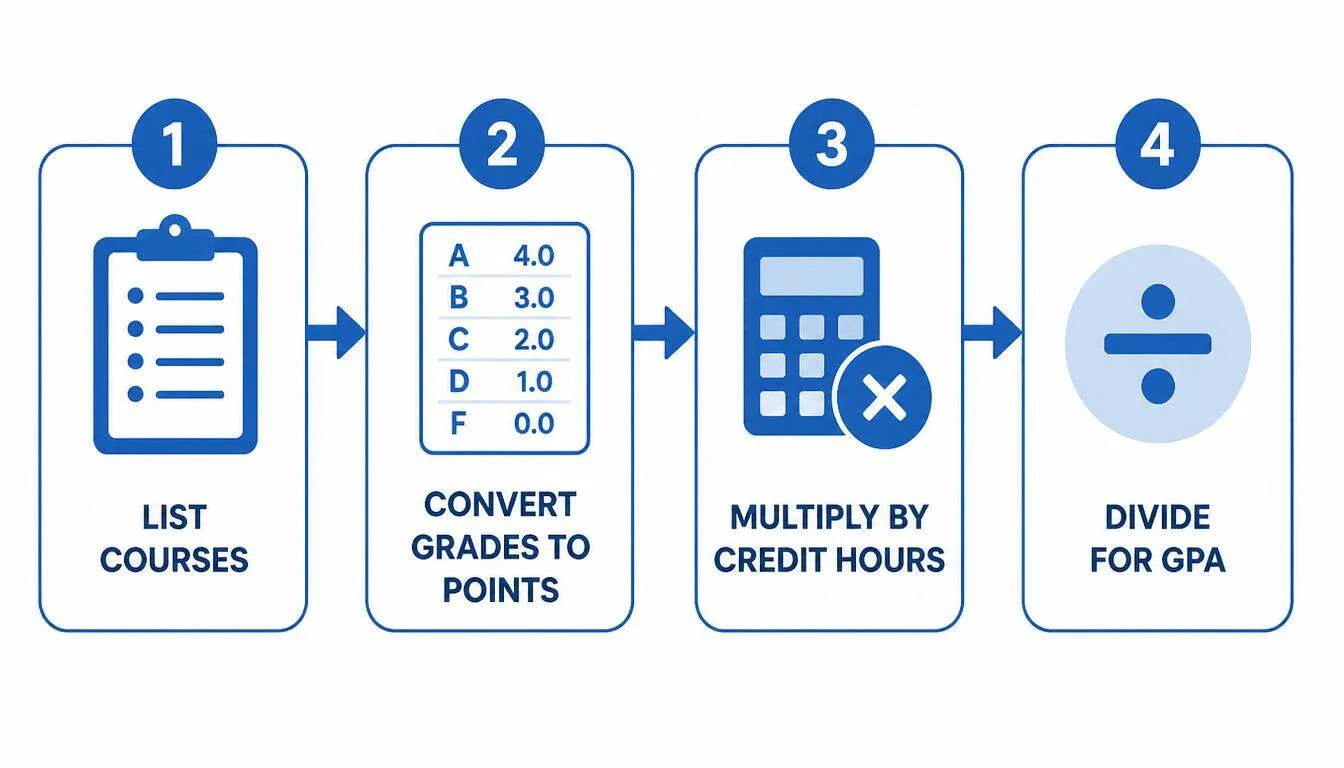
Calculating your GPA takes 4 steps. Work through a real example to see how it comes together.
1. List every course, its letter grade, and its credit hours.
2. Convert each letter grade to grade points using the table above.
3. Multiply grade points by credit hours for each course. This gives quality points.
4. Divide total quality points by total credit hours. The result is your GPA.
(https://www.scholaro.com/gpa-calculator/)
Example calculation
Say you took 4 courses last semester:
|
Course |
Credits |
Grade |
Grade Points |
Quality Points |
|
English 101 |
3 |
A |
4.0 |
12.0 |
|
Math 201 |
4 |
B+ |
3.3 |
13.2 |
|
History 110 |
3 |
C |
2.0 |
6.0 |
|
Chemistry 105 |
4 |
B- |
2.7 |
10.8 |
|
Total |
14 |
|
|
42.0 |
GPA = 42.0 ÷ 14 = 3.0
GPA Calculator with Pass/Fail Classes
Pass/fail grading removes letter grades from specific courses and records only P or F on your transcript. Most schools designed the option so students can take courses outside their major without risking their GPA on unfamiliar material.
How pass/fail affects your GPA
The standard rule at most schools: a Pass does not count toward GPA. A Fail may or may not count, depending on school policy. Here are the 3 common approaches:
• Pass and Fail both excluded. Neither result touches your GPA. This is the most student-friendly policy.
• Pass excluded, Fail included as 0.0. A Fail in a pass/fail course drops into your GPA the same way an F in a graded course would.
• Both counted as grades. Pass converts to a C (2.0) and Fail to an F (0.0). This is rare but exists at some schools.
Check your school's academic policies page or call the registrar. The difference between policies 1 and 2 above can mean the difference between a 3.2 GPA and a 2.9 GPA if you fail a 4-credit course.
Calculating GPA when you have pass/fail courses
Exclude pass/fail courses from your calculation entirely, unless your school's policy says to include the Fail.
Example: You took 5 courses. One was pass/fail and you passed. Use only the 4 graded courses to calculate your GPA. The pass/fail course does not add credits to your denominator or quality points to your numerator.
If you failed a pass/fail course and your school includes Fails, add the failed course's credit hours to the denominator and 0 quality points to the numerator. That 0 drags the average down.
When pass/fail makes sense
• You want to explore a subject far outside your major without academic risk.
• You are overloaded and one course needs to be lower-stakes.
• You are already above the GPA threshold for your goals and a bad grade in one hard course could pull you below it.
One caution: graduate schools and professional programs sometimes view heavy use of pass/fail as a red flag. Use it selectively.
How Failure in Some Classes Affects Your GPA
A single F can do serious damage. On a 4.0 scale, an F earns 0 grade points. That 0 pulls your weighted average down hard, especially for high-credit courses.
The math behind a failed course
If you have a 3.2 GPA across 45 credit hours and you fail a 4-credit course, here is what happens:
• Current quality points: 3.2 x 45 = 144
• Failed course adds: 0 quality points, 4 credit hours
• New GPA: 144 ÷ 49 = 2.94
One failed 4-credit course dropped that GPA from 3.2 to 2.94, which is roughly 0.26 points. That is the difference between a B+ average and a B average, and it can affect academic standing, scholarships, and graduate school eligibility.
Repeated courses
Most schools let you retake a failed course. Some schools replace the F with the new grade in the GPA calculation (grade replacement). Others average both grades. A few simply keep the F on the transcript but let you retake for credit.
Grade replacement is worth the effort in nearly every case. Retaking a course you failed and earning a B brings your quality points from 0 to 9 (for a 3-credit course), which can recover most of the GPA damage.
Surviving with a Low GPA: What to Do
A low GPA is a real obstacle, but it is not permanent. Here is what actually moves the number.
1. Audit your credit load
Overloading on credits while working part-time is the fastest way to earn C's and D's across 5 courses. Cut to 12-13 credits per semester, do them well, and your GPA climbs faster than taking 18 credits and performing at 60%.
2. Retake your worst courses first
A D in a 4-credit course is worth retaking before a C in a 2-credit course. Sort your failed or low-grade courses by credit hours, and retake the high-credit ones where your school allows grade replacement.
3. Find courses where you can earn A's
GPA recovery requires above-average grades, not average ones. Identify electives or general education courses where you have genuine interest or prior knowledge, take them seriously, and earn 4.0 in them.
4. Talk to your advisor before dropping classes
A late drop that becomes a W (withdrawal) is neutral for GPA but can hurt financial aid and academic standing at some schools. An advisor can tell you whether withdrawing or riding out a C is the better outcome.
5. Address the cause, not just the symptom
If the GPA is low because of personal circumstances, a documented medical or family situation, talk to your school's dean of students office. Some schools allow retroactive grade changes or hardship withdrawals that remove old F's from the GPA calculation.
6. Contextualize it in applications
A low GPA matters less when you can explain it specifically. Employers and graduate programs can read between the lines. An upward trend (1.8 freshman year, 3.1 senior year) reads differently than a flat 2.1 across 4 years. Write that story directly in your personal statement.
Frequently Asked Questions About GPA
What is a good GPA?
For most undergraduate programs, a 3.0 GPA is considered good. A 3.5 or above puts you in a strong position for graduate school, scholarships, and competitive employers. Below 2.0 is often the threshold for academic probation.
Does pass/fail hurt my GPA?
A Pass does not hurt your GPA at most schools. A Fail may hurt depending on your school's policy. Call the registrar and ask specifically: does a Fail in a pass/fail course count in GPA calculations?
How many credit hours does it take to raise my GPA by 0.1?
It depends on your current GPA and credit count. The more credits you have, the harder it is to move. If you have 60 credit hours and a 2.4 GPA, you'd need roughly 20 more credit hours of straight A's to reach a 2.8. A GPA calculator can run the exact numbers for your situation.
Can I remove an F from my transcript?
Usually not entirely. Grade replacement at most schools replaces the F in the GPA calculation but the F still appears on the transcript with a notation. True transcript erasure is rare and typically only available through formal academic forgiveness policies after a long break in enrollment.
Do graduate schools see my pass/fail courses?
Yes. Pass/fail courses appear on your transcript. Graduate programs can see how many courses you took pass/fail and which ones. A pattern of taking difficult courses pass/fail to avoid a grade can raise questions.
What GPA is needed for medical or law school?
Medical school averages vary by school, but most accepted applicants hold a 3.5 or above. Law school is similar; the top 14 programs typically see medians around 3.7-3.9. Both care about the full GPA and the trend, not just the number.
Is GPA all that matters?
No. Research experience, internships, test scores, recommendations, and essays all matter in graduate and professional school applications. Employers often care more about specific skills and project experience than GPA. A strong GPA with nothing else is less useful than a solid GPA with real-world experience.