
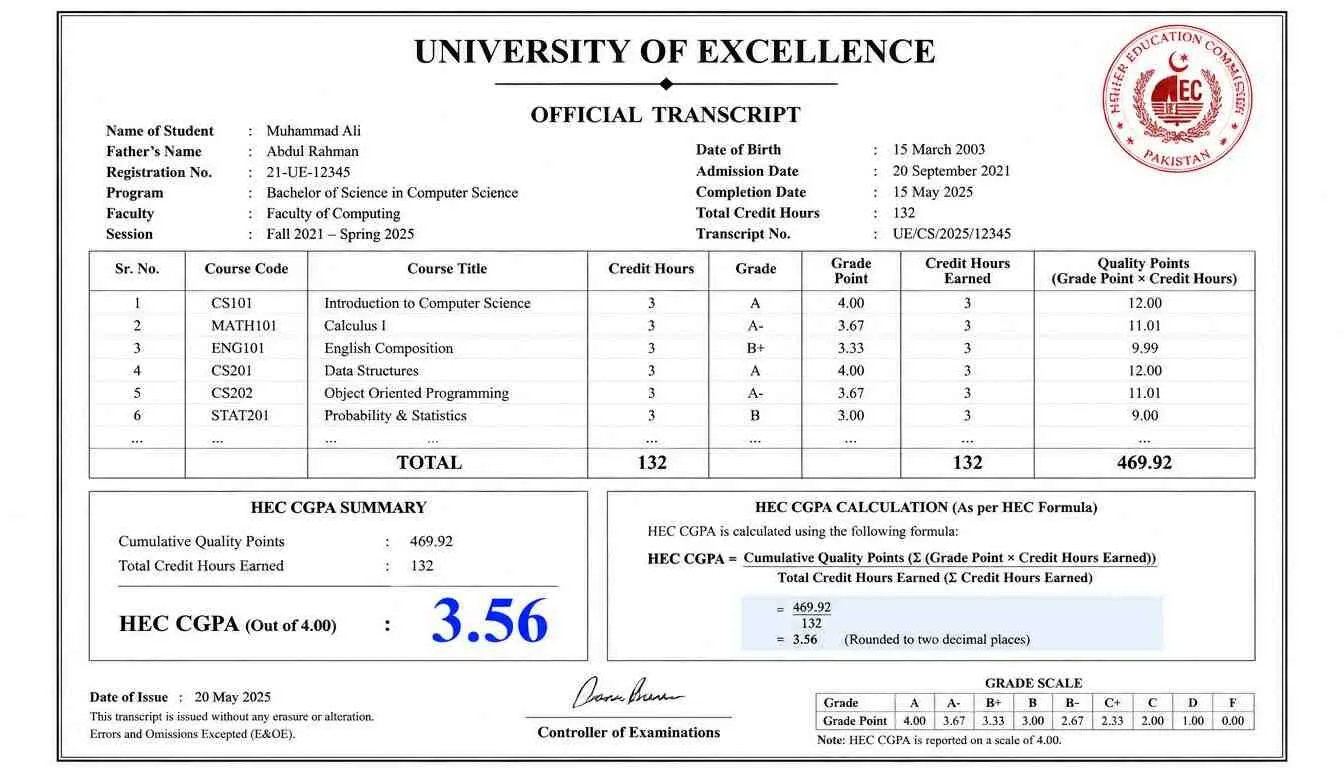
HEC CGPA: What It Is, How to Calculate It,and Why It Actually Matters
Let's be honest, when you first heard the term "HEC CGPA," you probably just nodded like you understood and quietly Googled it later. No shame in that. It's one of those things nobody properly explains in orientation week, yet it follows you around for the rest of your academic and professional life.
This guide covers everything you need to know: what HEC CGPA actually is, how to calculate it step by step, whether it genuinely affects your career, and most importantly, what you can do to improve it if things have not been going so great.
This article is based on the official Higher Education Commission (HEC) of Pakistan grading framework. All information references publicly available HEC policy documents and widely accepted academic grading standards.
What Is HEC CGPA?
CGPA stands for Cumulative Grade Point Average. In Pakistan, the Higher Education Commission (HEC) has standardized a grading system that all recognized universities are expected to follow. This system uses a 4.0 scale, where each letter grade maps to a specific grade point.
So when someone says "HEC CGPA," they are referring to the official cumulative GPA calculated under the grading framework issued by the HEC. It is not a separate score, it is your university CGPA calculated according to HEC's standardized criteria.
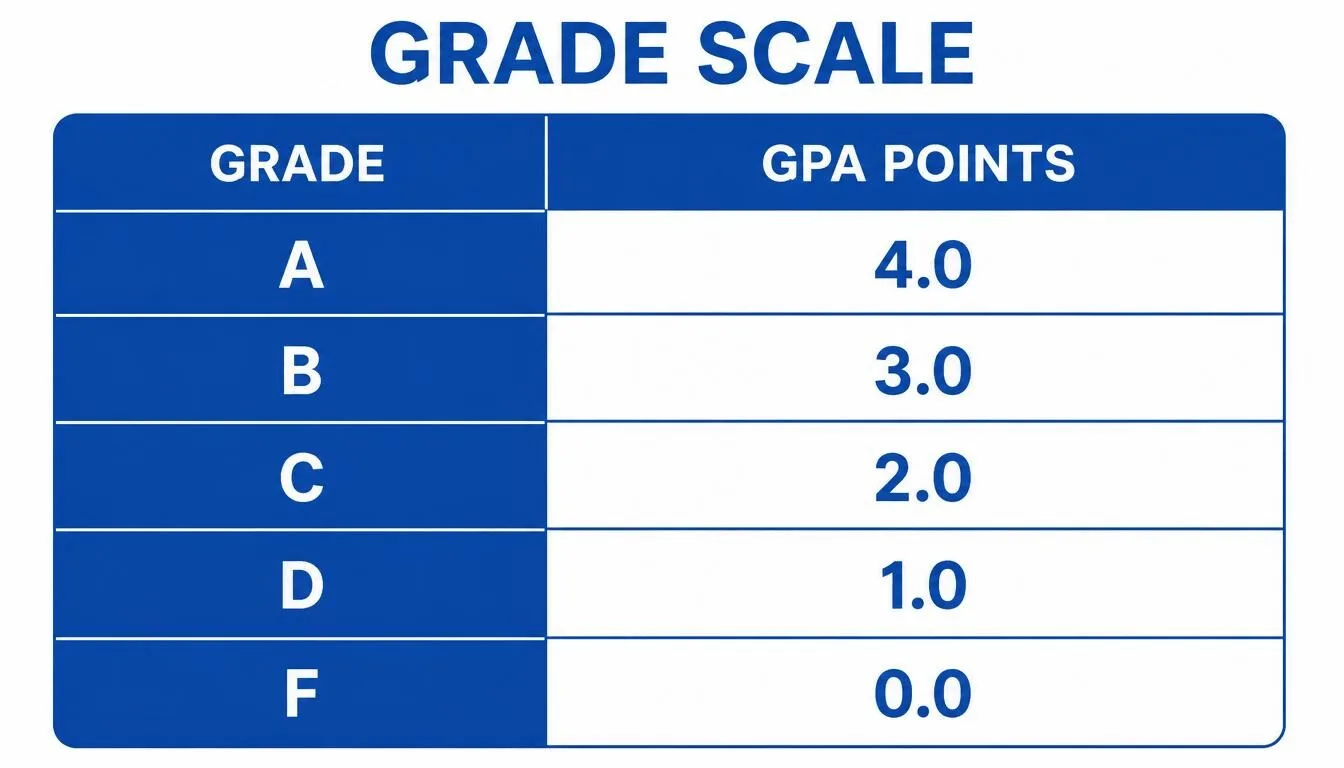
The Official HEC Grading Scale
According to HEC's undergraduate education policy, the standard grading scale looks like this:
• A — 4.00 Grade Points (Excellent)
• A- — 3.70 Grade Points
• B+ — 3.30 Grade Points
• B — 3.00 Grade Points (Good)
• B- — 2.70 Grade Points
• C+ — 2.30 Grade Points
• C — 2.00 Grade Points (Satisfactory)
• D — 1.00 Grade Point (Passing, but barely)
• F — 0.00 Grade Points (Fail — ouch)
The minimum passing CGPA for most HEC-recognized programs is 2.0 on this scale. Falling below that can result in academic probation or, in worst cases, dismissal. Source: HEC Undergraduate Education Policy, available at hec.gov.pk.
Step-by-Step Guide to Calculate HEC CGPA
Calculating your HEC CGPA is not complicated once you break it down. Here is a straightforward method you can follow manually, no fancy software needed.
Step 1: Note Your Grades and Credit Hours
For each subject, you need two things: the grade you received and the credit hours that subject carries. Credit hours are usually printed on your transcript or course outline.
Example: You took four courses this semester. Business Communication (3 credit hours, Grade B), Calculus (4 credit hours, Grade A-), Introduction to Computing (3 credit hours, Grade B+), and Pakistan Studies (2 credit hours, Grade A).
Step 2: Convert Grades to Grade Points
Using the HEC grading scale above, convert each grade to its numerical grade point value.
• Business Communication: B = 3.00
• Calculus: A- = 3.70
• Introduction to Computing: B+ = 3.30
• Pakistan Studies: A = 4.00
Step 3: Multiply Grade Points by Credit Hours
This gives you the "quality points" for each course.
• Business Communication: 3.00 × 3 = 9.00
• Calculus: 3.70 × 4 = 14.80
• Introduction to Computing: 3.30 × 3 = 9.90
• Pakistan Studies: 4.00 × 2 = 8.00
Step 4: Add Up Quality Points and Credit Hours
Total Quality Points: 9.00 + 14.80 + 9.90 + 8.00 = 41.70
Total Credit Hours: 3 + 4 + 3 + 2 = 12
Step 5: Divide Quality Points by Total Credit Hours
CGPA = Total Quality Points ÷ Total Credit Hours
CGPA = 41.70 ÷ 12 = 3.475 (approximately 3.48)
To calculate your cumulative CGPA across multiple semesters, repeat this process for all semesters combined. Add all quality points from every semester and divide by all credit hours taken in total.
Most universities in Pakistan now provide online portals where this is calculated automatically. But knowing how to do it manually means you can actually verify your transcript, which is more useful than most students realize.
Does HEC CGPA Matter to Your Career?
Short answer: yes, but it depends on where you want to go.
Long answer: it is complicated, and context matters more than people admit.
When Your HEC CGPA Matters a Lot
There are specific career paths and opportunities where your CGPA will be screened hard:
• Government and public sector jobs: Many federal and provincial government departments, along with agencies like FPSC and PPSC, have minimum CGPA cutoffs for eligibility. Positions in civil services often require a strong academic record.
• Higher education and academia: If you plan to pursue an MS or PhD, locally or abroad, your CGPA is often the first filter. HEC's own scholarship programs (like the HRDI overseas scholarship) typically require a minimum CGPA of 2.5, with competitive slots going to students above 3.0.
• Multinational corporations and graduate programmes: Companies like Unilever, P&G, Nestle, and many international banks include CGPA thresholds (usually 3.0 or above) in their initial screening criteria for graduate trainee and management trainee programmes.
• Campus recruitment: On-campus drives at universities like LUMS, IBA, and NUST often involve CGPA as an initial shortlisting factor. Below a certain threshold, your CV simply does not move forward.
When Your HEC CGPA Matters Less
Not every employer cares about your GPA. Here is where it takes a back seat:
• Startups and tech companies: In the local startup ecosystem and software industry, what you can build matters far more than what score you got. A GitHub portfolio and a deployed project often speak louder than a 3.8.
• Freelancing and self-employment: If you are going independent, clients care about your skills and your reviews, not your transcript.
• Creative industries: Advertising agencies, media houses, design studios, these fields care about your portfolio. A strong body of work will almost always beat a perfect CGPA.
• Experienced hires: After three to five years of relevant work experience, most employers barely glance at your academic record. Your professional track record takes over completely.
• According to a LinkedIn Talent Trends report, more than 70% of hiring managers globally consider skills and experience more important than grades after a candidate's first job. The CGPA matters most in your first two to three years post-graduation.
Methods to Improve Your HEC CGPA
If your current CGPA is not where you want it to be, you are not stuck. There are real, practical strategies that work, and no, none of them involve memorizing the night before the exam (well, not entirely).
1. Understand How Credit-Heavy Courses Affect Your Average
Not all courses are created equal. A 4-credit-hour course has twice the mathematical impact on your CGPA as a 2-credit-hour course. This means doing well in high-credit subjects can significantly boost your average. Prioritize accordingly — if you have limited study time, protect your grades in the heavier courses first.
2. Retake Courses Where Allowed
Many HEC-recognized universities allow students to retake a course in which they scored a D or F, with the better grade replacing or averaging out the old one. Check your university's academic regulations carefully. One improved grade in a 3-credit course can meaningfully lift your CGPA.
3. Take Extra Electives Strategically
If your institution permits it, take additional elective courses where you are confident of performing well. More quality points from more courses means your average goes up — provided you actually score well in those extras.
4. Seek Academic Support Early
Most universities have tutoring centres, faculty office hours, and peer learning programmes. The students who improve are not necessarily the smartest, they are the ones who ask for help before the exam, not after the result. Going to your professor three days before the midterm is not embarrassing. Failing and regretting it is worse.
5. Focus on Continuous Assessment, Not Just Finals
Under the HEC credit-hour system, most courses include quizzes, assignments, class participation, and mid-term exams alongside the final. Collectively, these internal assessments often carry 40 to 60 percent of the total grade. Students who write off internal marks are fighting a lost battle before the final even starts.
6. Address the Problem Courses Head-On
Identify your two or three lowest-performing subjects and build a specific plan for each. Is it a concept problem? A time management issue? A personality clash with the professor? Each has a different fix. Blanket studying rarely improves specific weaknesses.
Consistency beats cramming. Research consistently shows that spaced repetition and regular review outperform last-minute intensive study sessions when it comes to both retention and academic performance. (Source: cognitive psychology literature on spaced learning, popularized by platforms such as Anki and widely supported in education research).
Frequently Asked Questions (FAQs)
Here are the most common questions students ask about HEC CGPA, answered plainly:
|
Question |
Answer |
|
Is HEC CGPA required for a government job? |
It depends on the employer. Most government departments and public sector organizations do check your CGPA, especially for competitive roles like CSS or PAS. |
|
What is the minimum HEC CGPA for a scholarship? |
For most HEC-funded scholarships, a minimum CGPA of 2.5 out of 4.0 is required. Some competitive programs demand 3.0 or above. |
|
Can a low CGPA be overcome with experience? |
Yes. Strong work experience, certifications, and a solid portfolio can compensate, especially in private-sector hiring. |
|
Does repeat courses affect CGPA? |
It depends on university policy. Some institutions replace the old grade; others average both attempts. |
|
How do I verify my HEC CGPA officially? |
You can verify through your university transcript, which is attested by HEC. Visit hec.gov.pk for transcript attestation services. |
Personal Opinion
Here is an honest take, for what it is worth.
HEC CGPA is a real metric with real consequences — but it is not the only metric, and treating it as the sole measure of your potential is a mistake both students and some employers make.
If you are sitting at a 2.4 and feeling hopeless about your future, stop. A low CGPA is a setback, not a sentence. There are successful people across every industry in Pakistan who started with grades their transcripts are not proud of.
At the same time, if your CGPA is slipping and you are telling yourself it does not matter, be honest with yourself. It does matter in specific windows of your career — especially those first few years. Closing those doors prematurely is a choice you will feel later.
The smartest approach is to do both: work on your CGPA while also building real skills, real experience, and a real network. The students who do all three do not need to worry as much about which door is open and which is not — they build their own.
Your CGPA is a starting point, not a finish line. Use it wisely.