
Weighted GPA
A Complete Guide
1. What Is a Weighted GPA?
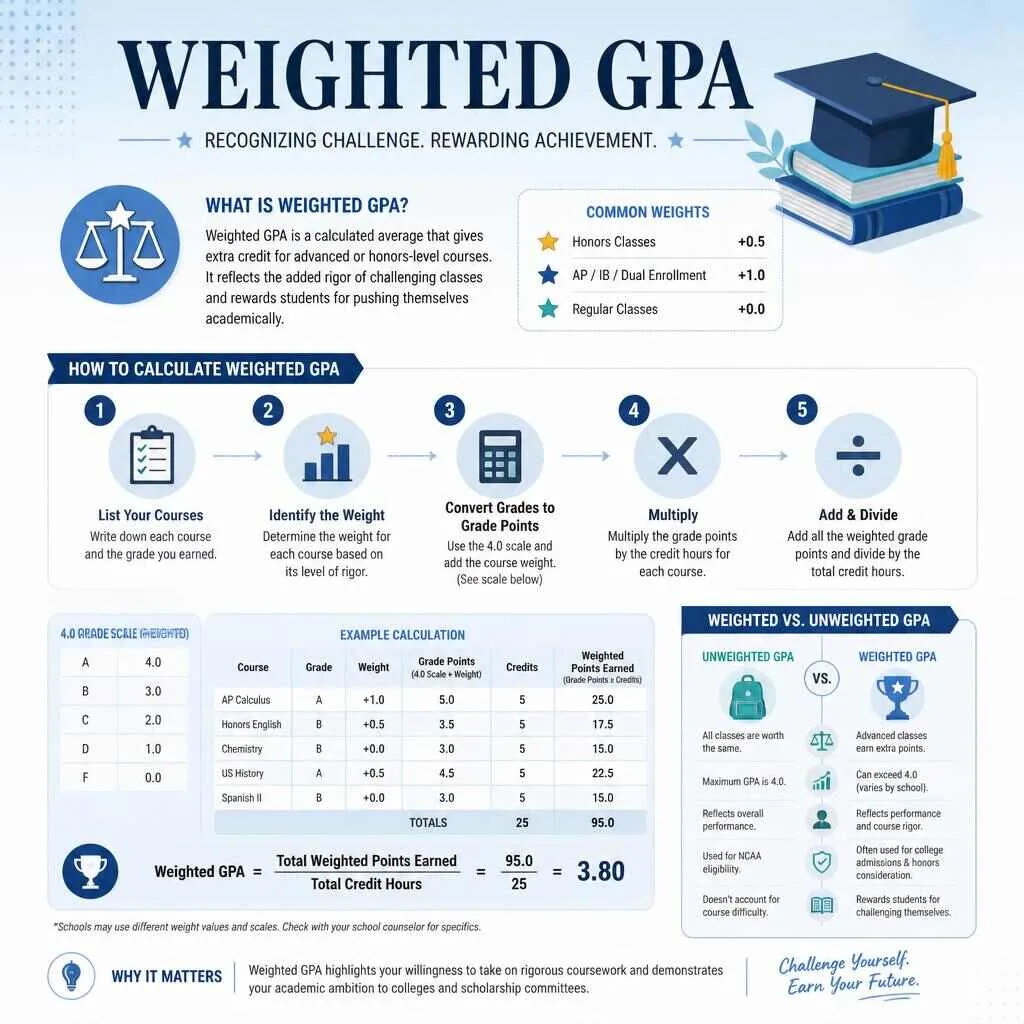
A weighted GPA accounts for course difficulty. It gives extra grade points for harder classes, such as Honors, Advanced Placement (AP), or International Baccalaureate (IB) courses.
A standard unweighted GPA runs from 0.0GPA to 4.0GPA . A weighted GPA typically runs from 0.0 to 5.0, though some schools use different scales.
Example: An A in a regular class earns 4.0GPA points. That same A in an AP class earns 5.0 GPA points on a weighted scale.
2. Weighted vs. Unweighted GPA
Here is a direct comparison of both scales:
|
Letter Grade |
Unweighted |
Weighted (Honors) |
Weighted (AP/IB) |
|
A+ |
4.0 |
4.5 |
5.0 |
|
A |
4.0 |
4.5 |
5.0 |
|
A- |
3.7 |
4.2 |
4.7 |
|
B+ |
3.3 |
3.8 |
4.3 |
|
B |
3.0 |
3.5 |
4.0 |
|
B- |
2.7 |
3.2 |
3.7 |
|
C+ |
2.3 |
2.8 |
3.3 |
|
C |
2.0 |
2.5 |
3.0 |
|
D |
1.0 |
1.5 |
2.0 |
|
F |
0.0 |
0.0 |
0.0 |
Key differences:
• Unweighted GPA: same 4.0GPA scale for every course, regardless of difficulty
• Weighted GPA: adds 0.5GPA points for Honors and 1.0 GPA point for AP/IB courses
• Colleges often recalculate GPAs using their own formula, regardless of what your transcript shows
3. Methods to Calculate Weighted GPA
Method 1: The Standard Point-Add Method
This is the most common approach. Add extra points based on course level, then calculate the GPA normally.
Grade point scale:
• Regular course: standard 4.0GPA scale
• Honors course: add 0.5GPA to each grade point
• AP or IB course: add 1.0GPA to each grade point
Method 2: The Quality Points Method
Multiply each course's grade points by the number of credit hours. Add the totals. Divide by total credit hours.
|
Course |
Type |
Grade |
Points |
Credits x Points |
|
English |
Regular |
A |
4.0 |
4.0 x 1 = 4.0 |
|
Calculus |
AP |
B |
4.0 |
4.0 x 1 = 4.0 |
|
History |
Honors |
A |
4.5 |
4.5 x 1 = 4.5 |
|
Biology |
AP |
A |
5.0 |
5.0 x 1 = 5.0 |
|
Spanish |
Regular |
B |
3.0 |
3.0 x 1 = 3.0 |
|
Total |
|
|
|
20.5 / 5 = 4.1 |
Method 3: Percentage-Based Conversion
Some schools assign grade points based on percentage scores rather than letter grades. Each school sets its own conversion table.
Example: 97-100% = 4.0, 93-96% = 4.0, 90-92% = 3.7, etc. The weighted bonus is added on top of the converted value.
4. Step-by-Step Calculation
Follow these 5 steps to calculate your weighted GPA:
1. List every course you have taken, along with its grade and type (Regular, Honors, AP/IB).
2. Convert each letter grade to a grade point using the weighted scale. Add 0.5 for Honors and 1.0 for AP/IB.
3. Multiply each course's grade points by its credit value (most courses = 1 credit; some semester courses = 0.5).
4. Add all the weighted quality points together.
5. Divide the total by the total number of credits. This is your weighted GPA.
Worked Example
A student takes 5 courses in one semester:
|
Course |
Level |
Grade |
Grade Pts |
Credits |
|
AP Chemistry |
AP |
A |
5.0 |
1.0 |
|
Honors English |
Honors |
B+ |
3.8 |
1.0 |
|
Regular Math |
Regular |
A- |
3.7 |
1.0 |
|
AP History |
AP |
B |
4.0 |
1.0 |
|
Regular PE |
Regular |
A |
4.0 |
0.5 |
Calculation: (5.0 + 3.8 + 3.7 + 4.0 + 2.0) / 4.5 credits = 18.5 / 4.5 = 4.11 weighted GPA
Note: PE is 0.5 credits, so its quality points = 4.0 x 0.5 = 2.0.
5. Frequently Asked Questions
Do all colleges use weighted GPA?
No. Many colleges recalculate your GPA from scratch using their own formula when they receive your transcript. Some ignore weighted grades entirely and evaluate course rigor separately.

Is a 4.5 weighted GPA good?
Yes. A 4.5 weighted GPA generally means you are earning mostly A grades in Honors or AP courses. For highly selective colleges, a 4.5 is competitive, though admissions also consider test scores, essays, and extracurriculars.
Should I take harder courses for a higher weighted GPA?
Only if you can maintain strong grades. A B in an AP course gives you 4.0 weighted points. An A in a regular course also gives you 4.0. Taking an AP course and getting a C (3.0 weighted) is worse than an A in a regular course.
Does weighted GPA appear on my transcript?
This depends on your school. Some schools report both weighted and unweighted GPA. Others only report one. Check with your school counselor.
What is a good weighted GPA?
A general benchmark:
• 4.0 and above: strong performance in at least some advanced courses
• 4.5 and above: consistently strong grades in Honors or AP courses
• 4.8 and above: near-perfect grades across mostly AP/IB coursework
Can my weighted GPA go above 5.0?
On a standard 5.0 scale, no. Some schools use a 6.0 scale or assign different bonus values. Always check your school's specific policy.
6. My Take on Weighted GPA
Weighted GPA is a useful signal, but it can mislead both students and counselors if read in isolation.
The main problem: two students can have the same weighted GPA through very different paths. One takes 8 AP courses and earns B's across the board. Another takes 4 AP courses and earns straight A's. Their weighted GPAs might match, but their preparation and workload differ significantly.
Colleges know this. Admissions officers at selective schools look at the full transcript, not just the final number. The course rigor column matters as much as the GPA column.
For students, the practical advice is simple: take harder courses where you can genuinely perform well. A weighted GPA built on strong grades in 4 to 5 AP courses will carry more weight than one inflated by mediocre grades in 10.
Unweighted GPA still matters. It shows your baseline performance stripped of course-level inflation. If your unweighted GPA drops significantly as you add more AP courses, that is worth paying attention to.
https://www.indeed.com/career-advice/career-development/how-to-calculate-weighted-gpa