
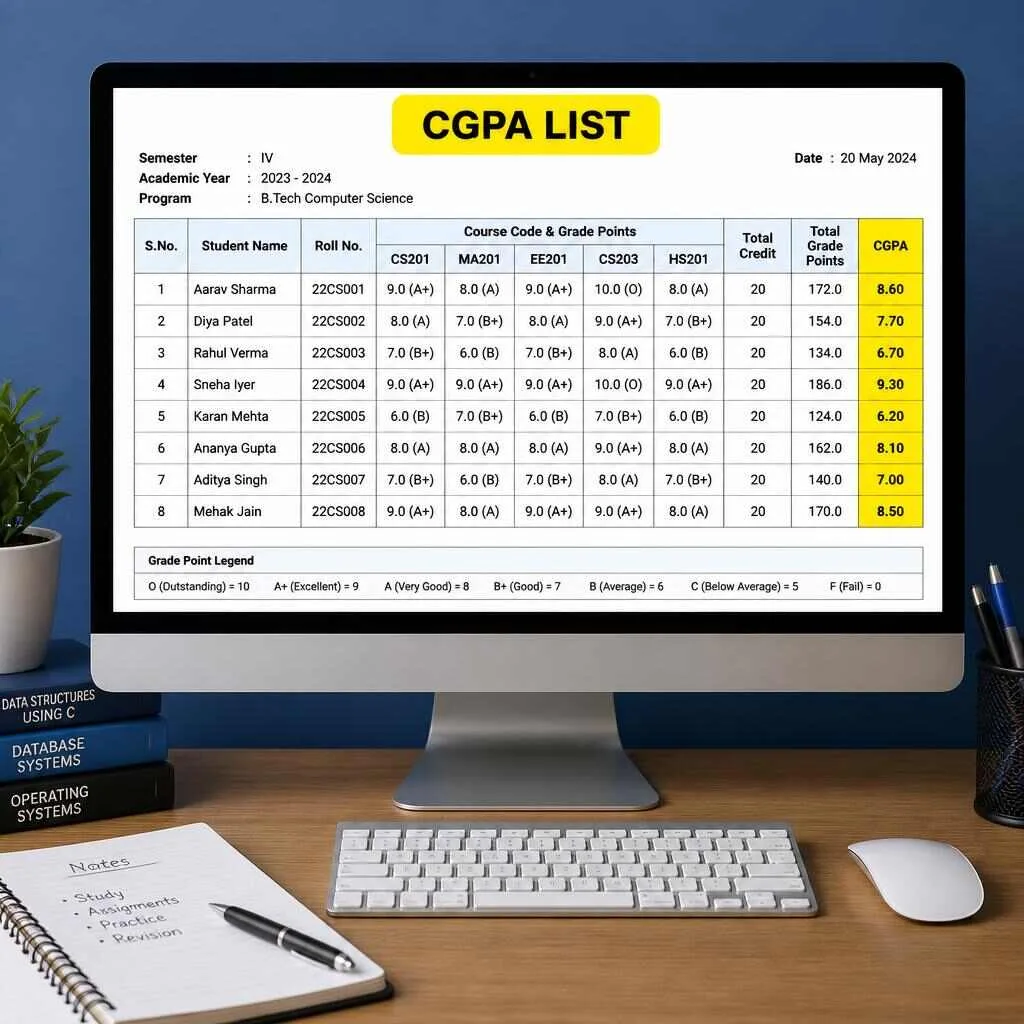
CGPA List Explained: What It Is, Who Provides It, and Why It Still Matters
You have probably heard the term CGPA thrown around during every exam season. Your parents ask about it. Your university puts it on every marksheet. Job recruiters sometimes demand it. But do you actually know what a CGPA list is, how it works, and whether it has any real impact on your life after graduation?
Let's break it all down clearly, without the academic jargon and without putting you to sleep.
What Is a CGPA List?
CGPA stands for Cumulative Grade Point Average. A CGPA list is an official document or ranking that records the academic performance of students across multiple semesters or academic years.
Think of it as a running scoreboard of your academic life. Every course you take, every exam you sit, every assignment you submit, it all feeds into one number. That number is your CGPA, and the list is simply a compiled record of all students and their respective scores.
Unlike a single semester GPA (which only reflects one term), the CGPA list gives a cumulative picture. It averages your performance from day one of university to the very last semester you complete.
Quick Fact: Most universities in Pakistan, the US, UK, and other countries use a 4.0 scale for CGPA. Some institutions use a 5.0 scale. Always confirm your institution's grading rubric before comparing scores with peers from other universities.
What Is Meant by a CGPA List in Academic Institutions?
In an academic context, a CGPA list serves multiple purposes. It is not just a number on your transcript. It is a structured document that universities maintain to:
• Track student performance over the entire degree duration
• Identify top-performing students for scholarships and awards
• Determine academic standing (good standing, probation, or dismissal)
• Certify academic achievement at the time of graduation
Many universities publish merit lists based on CGPA at the end of each semester. This becomes especially relevant during scholarship announcements, dean's list recognition, or honor roll compilations.
In simple terms, your position on the CGPA list reflects where you stand academically among your peers. It is objective, transparent, and calculated using a standardized formula.
How Is CGPA Calculated?
The formula is straightforward:
CGPA = Total Grade Points Earned ÷ Total Credit Hours Attempted
Each course carries a specific number of credit hours, and each grade corresponds to a grade point (for example, A = 4.0, B = 3.0, C = 2.0, and so on). Multiply the grade point by the credit hours for each course, add them all up, then divide by total credit hours. That is your CGPA.
Who Provides the CGPA List?
This is a question many students overlook. The CGPA list is not something you generate yourself (unfortunately, imagine the grade inflation if that were possible). It is officially provided by your academic institution.
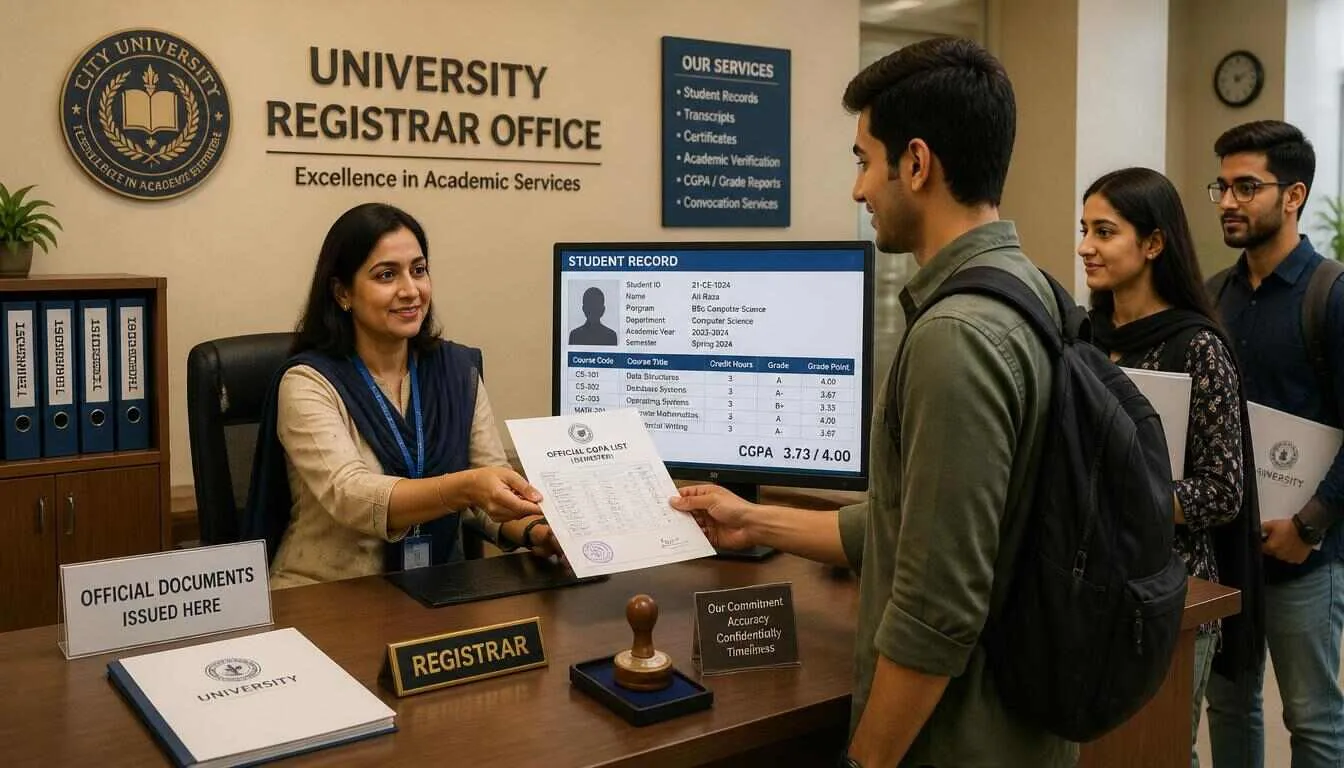
Here is who specifically handles it:
1. University Registrar's Office
The registrar is the official record keeper of any university. They compile, maintain, and issue CGPA records. When you request a transcript, it comes from this office. The CGPA list published at the end of each semester is also their responsibility.
2. Academic Affairs or Examination Departments
Many universities have a dedicated examination or academic affairs department that processes exam results, calculates grade points, and generates the final CGPA. They work closely with the registrar to ensure accuracy.
3. Learning Management Systems (LMS)
In the digital age, most universities use platforms like Blackboard, Moodle, or their own student portals. These platforms automatically calculate and display your real-time CGPA as grades are posted. However, the official CGPA list is always issued by the institution itself.
4. Government and Regulatory Bodies (In Some Cases)
For professional degree programs like medicine, engineering, or law, national regulatory bodies may maintain their own records. In Pakistan, for instance, the Higher Education Commission (HEC) maintains standards for how CGPA is reported across universities.
The bottom line: trust only your institution's official CGPA list. Any third-party claim about your CGPA is not legally valid for academic or professional purposes.
What Affects Your CGPA List Standing?
Your CGPA does not just depend on how hard you studied the night before the final exam (though that certainly helps). Several factors influence your cumulative score, and understanding them gives you a real advantage.
1. Grades in Individual Courses
This is the most obvious factor. The higher your grade in each course, the better your CGPA. A single failed course can pull down your average significantly, especially if it carries high credit hours.
2. Credit Hours Weightage
Not all courses carry equal weight. A 3-credit-hour course has more impact on your CGPA than a 1-credit-hour lab session. Performing well in high-credit courses gives your CGPA a bigger boost.
3. Repeated Courses
Many universities allow students to retake failed or low-grade courses. Policies differ, some replace the old grade entirely, while others average both attempts. Always check your institution's policy before repeating a course.
4. Academic Dishonesty
Getting caught cheating can result in an F grade, academic probation, or even suspension. Beyond the ethical issues, a single integrity violation can tank a CGPA that took years to build. Not worth it.
5. Withdrawal and Incomplete Grades
Withdrawing from a course after the deadline or receiving an incomplete grade can affect your CGPA calculation depending on your institution's grading policies. Some schools assign a 0.0 for incomplete courses if unresolved by a certain date.
6. Pass/Fail Courses
Courses graded on a pass/fail basis typically do not count toward CGPA calculations. This is both a relief and a limitation, they cannot hurt you, but they cannot help you either.
Does CGPA Affect Your Career?
Here is the real question everyone wants answered. And the honest answer is: it depends, but more than you might want it to.
When CGPA Matters a Lot
For fresh graduates, CGPA is often one of the few measurable indicators employers have. If you have zero work experience, your CGPA becomes a proxy for discipline, consistency, and academic ability.
Industries where CGPA carries real weight include:
• Investment banking and finance (many firms use a 3.5/4.0 cutoff)
• Graduate school admissions (GPA is a major selection criterion)
• Government jobs requiring merit-based hiring
• Scholarships for higher education (both domestic and international)
• Competitive corporate training programs
When CGPA Matters Less
Once you have two to three years of professional work experience, most hiring managers care far more about what you have done than what grade you got in your third-year economics class.
In creative industries, tech startups, and entrepreneurship, CGPA is rarely a deciding factor. Skills, portfolio, and problem-solving ability take center stage.
The Research Is Clear
A study by the National Association of Colleges and Employers (NACE) found that 67 percent of employers screen candidates by GPA, and many set a minimum threshold of 3.0 on a 4.0 scale. However, the same study notes that GPA alone is rarely the sole reason for a hiring decision, it gets you in the door, but your interview performance keeps you there.
Important note: A high CGPA with no soft skills, internships, or extracurriculars is not a golden ticket. Equally, a lower CGPA backed by strong experience and character can absolutely open major doors. Think of CGPA as one chapter in a larger story, not the whole book.
Frequently Asked Questions (FAQs) About the CGPA List
Q1: What is a good CGPA?
Most employers and graduate schools consider a CGPA of 3.0 or above (on a 4.0 scale) as competitive. A 3.5 or higher is generally considered excellent. However, standards vary by industry, country, and institution.
Q2: Can I improve my CGPA in my final year?
Yes, but the impact depends on how many semesters remain. The earlier you address poor grades through retakes or improved performance, the more room you have to recover. In the final semester alone, dramatic improvement is mathematically limited.
Q3: Is CGPA the same as GPA?
GPA (Grade Point Average) refers to your performance in a single semester or year. CGPA (Cumulative GPA) is the average across all completed semesters. CGPA gives a more complete picture of your overall academic performance.
Q4: Can employers verify my CGPA?
Yes. Most employers can request an official transcript directly from your university. Falsifying your CGPA on a resume is considered fraud and can result in immediate disqualification or termination if discovered after hiring.
Q5: Does every university use the same CGPA system?
No. Grading scales differ across institutions and countries. Some use a 4.0 scale, others use 5.0, 7.0, or even 10.0. Always clarify the scale when comparing CGPAs across different academic systems.
Q6: What happens if my CGPA is below the minimum requirement?
Most universities place students on academic probation if their CGPA falls below a certain threshold (commonly 2.0 on a 4.0 scale). If it remains low, students may face suspension or dismissal. Contact your academic advisor immediately if you are at risk.
Final Thoughts
The CGPA list is more than just a number on a piece of paper. It represents years of effort, consistency, and academic decisions, both good and not-so-good. Understanding what it means, how it is calculated, and who provides it gives you the knowledge to manage it proactively.
Does CGPA affect your career? Yes, especially early on. But it is never the only thing that defines you. Pair strong academics with real-world skills, genuine curiosity, and professional integrity, and your CGPA becomes one impressive item in an already strong profile.
So stop just checking where you rank on the CGPA list. Start understanding why you are there, and what you want to do about it.