

How Final Grades Are Calculated: A Complete Student Guide
Everything students need to know about final grades — what they mean, how they are calculated step by step, and why they matter for your career.
At the end of every semester, millions of students stare at the same question: how did my professor turn months of work into a single number? That number, your final grade, shapes scholarships, academic standing, career opportunities, and sometimes a very uncomfortable conversation with your parents.
Understanding how they are calculated is not just useful. For any student who wants to perform strategically rather than just hope for the best, it is essential.
This guide covers every angle, what the term actually means, a step-by-step calculation method, the key factors that affect them, their real career impact, and honest answers to the questions students search for most.
What Is Meant by Final Grades?
A final grade is the official academic result a student receives at the end of a course or academic term. It represents total performance across all assessed work, not just the last exam, and not just attendance. It is the complete picture.
According to the National Center for Education Statistics (NCES), grading systems in the United States most commonly use letter grades paired with a Grade Point Average (GPA) scale. The standard breakdown looks like this:
· A (90–100%) = 4.0 grade points — Excellent
· B (80–89%) = 3.0 grade points — Above average
· C (70–79%) = 2.0 grade points — Satisfactory
· D (60–69%) = 1.0 grade points — Below average, passing
· F (below 60%) = 0.0 grade points — Failing
They appear on official transcripts, factor into GPA calculations, determine academic standing, and influence everything from financial aid to graduate school applications.
Some institutions also use a plus and minus system — A+, A, A-, B+, and so on, which creates finer distinctions within each letter grade. A student who earns an A- receives 3.7 grade points rather than 4.0, which sounds minor until you calculate it across an entire degree.
How Final Grades Are Calculated: The Core Methods
Not all courses use the same calculation method. The approach depends on the institution, the instructor, and the course type.
The Weighted Average Method
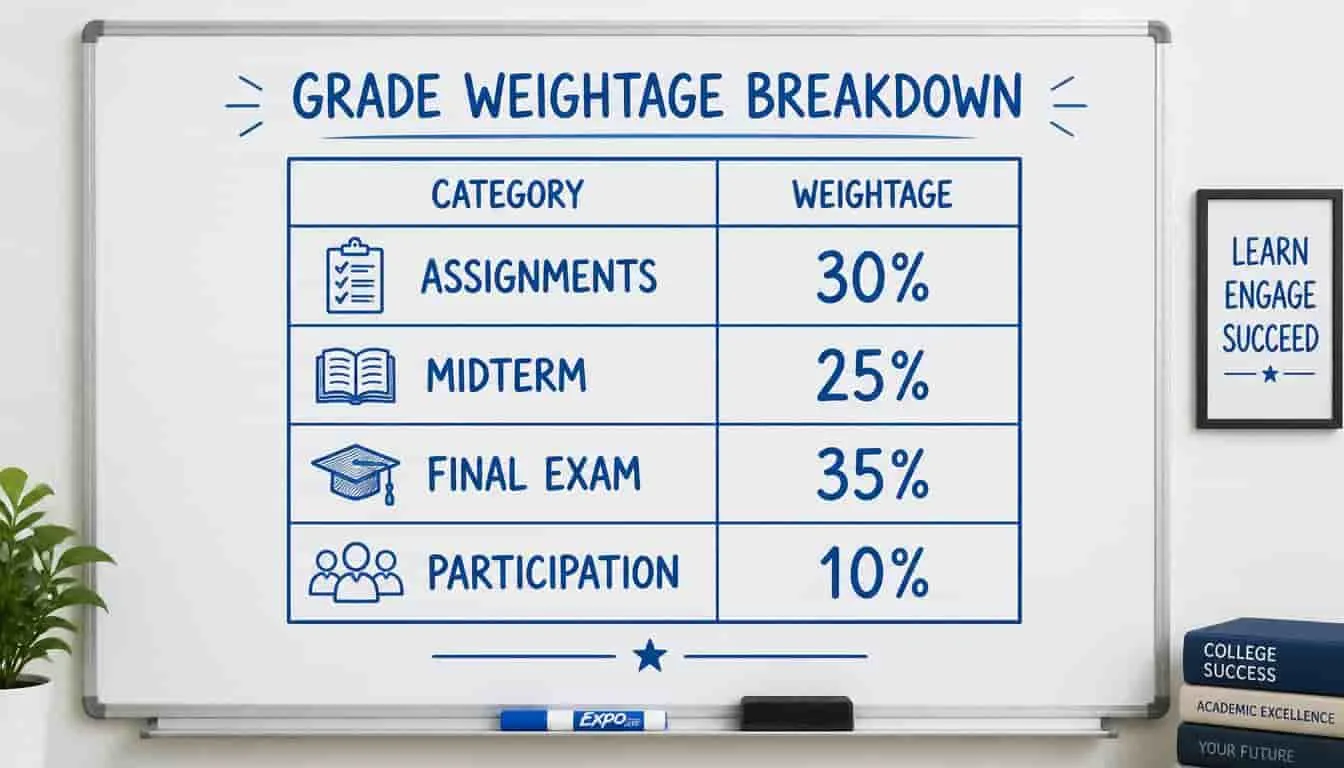
Most university courses use weighted averages. Each category of assessed work carries a set percentage of the overall result.
A typical course breakdown might look like this:
· Assignments and homework: 25%
· Midterm examination: 25%
· Final examination: 40%
· Class participation: 10%
To calculate the final grade, you multiply each score by its weight, then add the results. If a student scored 82% on assignments, 74% on the midterm, 88% on the final exam, and 95% on participation:
(82 × 0.25) + (74 × 0.25) + (88 × 0.40) + (95 × 0.10) = 20.5 + 18.5 + 35.2 + 9.5 = 83.7%
That result of 83.7% converts to a B on the standard scale. Now the mystery is gone.
The Points-Based Method
Some instructors assign point values to every piece of work rather than percentages. Your score equals total points earned divided by total points possible.
If a course has 600 total points and a student earns 510, the result is 510 ÷ 600 = 85% — a solid B. This system is straightforward and easy to track.
The Simple Average Method
Less common at university level but still used in some high school settings, the simple average adds all scores together and divides by the total number of scores. Every assessment carries equal weight regardless of its type or difficulty.
Step-by-Step Guide to Calculate Your Final Grades
Here is a practical, repeatable process you can apply to any course right now. Students who do this calculation mid-semester, not just at the end, consistently perform better because they know exactly where they stand.
Step 1 — Get Your Syllabus and Note Every Weight
Your syllabus lists every graded component and its percentage weight. Write these down in a simple table. This is your grading map. If you have lost the syllabus, find it on your course portal or email your instructor.
Step 2 — Record Your Score for Each Component
Next to each graded item, record the score you received as a percentage. If you received 36 out of 40 on a quiz, convert it: 36 ÷ 40 × 100 = 90%. Keep everything in percentage format for consistency.
Step 3 — Multiply Each Score by Its Weight
Convert each weight from a percentage to a decimal (25% becomes 0.25) and multiply it by your score for that component. This gives the weighted contribution of each item.
Step 4 — Add All Weighted Scores Together
Sum all the weighted scores from Step 3. The total is your current standing as a percentage. Compare it against your institution's grading scale to find your letter grade.
Step 5 — Project Your Final Grade Before the Semester Ends
If some components are still outstanding, assign your realistic target score to each remaining item and recalculate. This projection tells you exactly what you need to achieve your target.
Many university registrar websites offer free grade calculators for this purpose. Tools like RogerHub allow you to input current scores and target results to see precisely what you need on remaining assessments.
Key Factors That Affect Your Final Grades
Many students focus only on exam scores. In reality, several factors shape the result, some academic, some behavioural, some entirely within your control.
1. Assessment Weighting
The single biggest structural factor is how much each component weighs. A 40% exam deserves 40% of your preparation energy.
2. Attendance and Participation
Many courses include attendance or class participation as a graded component, typically ranging from 5% to 15%. Beyond the direct grade impact, research published in Active Learning in Higher Education found that regular attendance correlates strongly with higher exam scores, meaning skipping class hits your final grade twice.
3. Assignment Consistency
Students who submit consistent, complete work across all smaller assignments build a strong grade foundation before major exams. Missing or incomplete assignments create a deficit that even a strong final exam performance struggles to overcome, depending on the weighting structure.
4. Academic Integrity Violations
Plagiarism, unauthorised collaboration, or any academic dishonesty can result in a zero on an assessment, failure of the course, or in serious cases, academic dismissal. According to the International Center for Academic Integrity (ICAI), academic dishonesty affects final grades not just through penalties but through the loss of genuine learning that assessments are designed to build.
5. Curve Adjustments
Some instructors apply a curve when the class average falls significantly below expectations. A curve adjusts scores upward, but curves are never guaranteed. Building your study strategy around hoping for one is not a plan. It is a gamble.
6. Late Submission Penalties
Most syllabi include a late penalty policy, commonly 5% to 10% deducted per day. Over several assignments, these penalties can meaningfully drag down a result that strong exam performance cannot fully rescue.
The Real Impact of Final Grades on Your Career
Here is the honest picture of where your academic record actually matters, and where it fades into the background.
Graduate School Admissions
For students planning postgraduate education, your academic transcript is among the most important application factors. According to GMAC, admitted students at top MBA programmes typically hold a GPA between 3.4 and 3.9 on a 4.0 scale.
Scholarship and Financial Aid Eligibility
Most merit-based scholarships require a minimum GPA, typically 3.0 to 3.5 , built directly from your semester results. Falling below the threshold risks losing existing funding mid-degree.
Entry-Level Employment
According to the National Association of Colleges and Employers (NACE) Job Outlook Survey, approximately 30 to 35 percent of employers screen graduate applicants by GPA, with 3.0 as the most common minimum threshold. Industries like finance, consulting, engineering, and technology apply this filter most consistently. Final grades that produce a competitive GPA keep you visible to these employers at the application stage.
Academic Standing and Progression
Poor academic results can place students on probation, restrict course selection, delay graduation, or in repeated cases, result in academic dismissal. Most universities require a minimum cumulative GPA of 2.0 to remain in good standing.
Long-Term Career Trajectory
After two to three years of professional experience, your GPA and academic record recede as hiring factors. Employers shift focus to work history, skills, and demonstrated results.
Frequently Asked Questions About Final Grades
Q: Can one failed assignment ruin my final grade?
It depends entirely on the weight. A zero on a 5% quiz creates a maximum 5-point deficit, manageable with strong performance elsewhere. A zero on a 40% exam is a much more serious problem.
Q: What is the minimum final grade to pass a course?
This varies by institution and programme. Most US high schools set the passing threshold at 60% to 65% (grade D). Most undergraduate programmes require a C (70% to 73%) or higher in core courses. Graduate programmes typically require a B (80%) minimum to remain in good standing. Always check your institution's academic regulations for the specific threshold.
Q: How much can a final exam change my final grade?
Exactly as much as its weight allows. If your exam is worth 40% and you have an 80% going in, scoring 100% can push your result to 88%. Scoring 50% could drop it to 68%.
Q: Can I dispute a final grade?
Yes, with evidence. Most institutions have a formal grade appeal process. If you believe a calculation error occurred or an assessment was graded inconsistently, you can request a review through your department or academic office. Appeals based on genuine errors succeed. Appeals based on disagreement with fair marking rarely do.
Q: Does a late withdrawal (W) affect my final grade?
A W on your transcript indicates withdrawal, it does not count as a fail and does not factor into your GPA in most institutions. However, excessive withdrawals can affect financial aid eligibility.
Q: How do I calculate what I need on my final exam to pass?
Use this formula: subtract your current weighted score (excluding the final exam) from your target, then divide by the exam weight. Online calculators like RogerHub make this instant and error-free.
Personal Opinion: What Final Grades Actually Tell You
Here is a perspective worth having before you spend the next semester anxious about decimal points.
They measure something real, your ability to understand material, manage time, meet deadlines, and perform under defined conditions over an extended period.
But they do not measure everything. They do not capture curiosity, creativity, resilience, or the ability to solve problems that have not been written into a rubric yet.
The students who perform best over a full degree, not just in one semester, are usually the ones who understand the grading system clearly, use it strategically, and focus on genuine learning rather than just chasing a number.
Understand the calculation. Track your standing actively. Improve it with intentional effort. And then remember that academic results are a useful tool, not a ceiling on what you are capable of.