
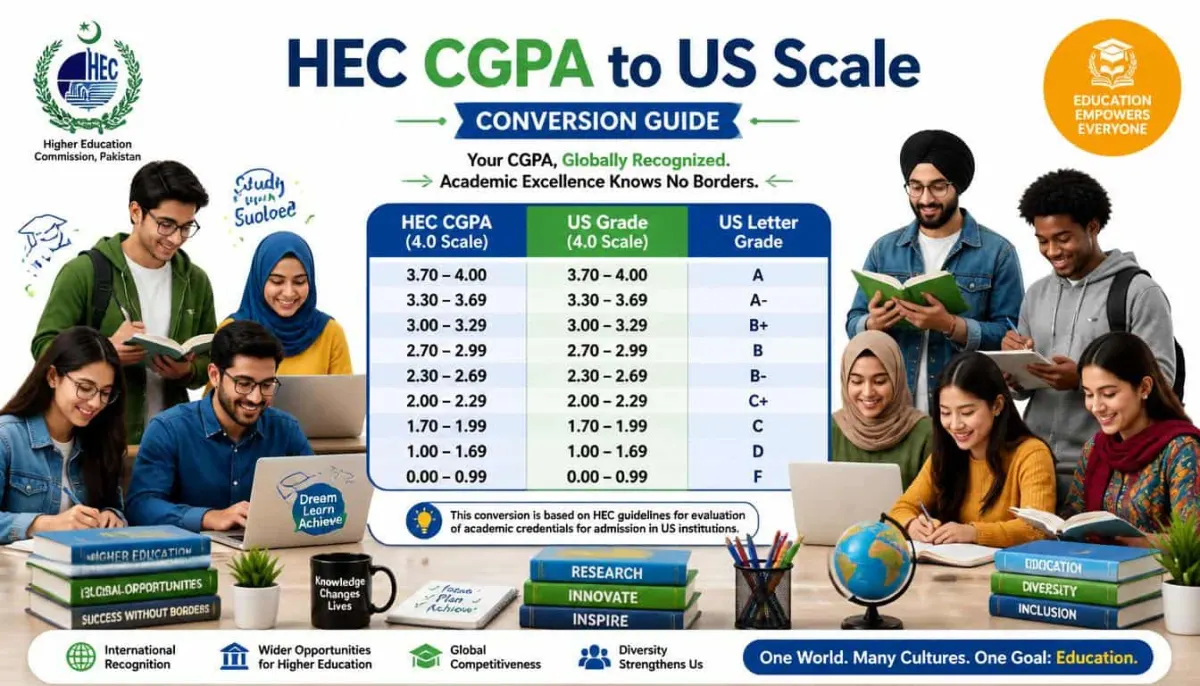
How to Convert HEC CGPA to US Scale (2026 Guide)
Applying to a university in the United States is a big deal for many students from Pakistan. But figuring out how to convert your HEC Pakistan CGPA to the US scale can be really tough. The problem is that while both systems use a 4.0 scale, they are not the same. The Higher Education Commission (HEC) standards and the American grading system differ significantly in their weightage.
If you are looking at your transcript and wondering if your 3.2 CGPA is "good enough" for a US university, you are not alone. Many students get confused during the application process or when getting transcripts evaluated by World Education Services (WES). In this guide, we will break down the HEC CGPA to US Scale, and give you a clear roadmap to calculate your GPA.
1. Understanding the Difference: HEC vs. US Grading Systems
You need to know that a 3.5 CGPA in Pakistan is not the same as a 3.5 GPA in the United States. In Pakistan, the grading is often stricter. For example, obtaining 90% or above is very difficult in Pakistani universities, whereas in the US, an "A" grade typically starts at 90% or 93%.
The US Standard 4.0 Scale
In the US system, each letter grade has a fixed numerical value:
-
A = 4.0
-
B = 3.0
-
C = 2.0
-
D = 1.0
-
F = 0.0
The HEC Fractional System
HEC Pakistan uses a different approach. A CGPA of 3.63 to 4.00 is considered the top tier (equivalent to 90–100% marks). Because of these differences, Pakistani students often find that their converted US GPA is higher than their local one.
2. The Official HEC CGPA to US SCALE Percentage Formula
To convert your CGPA accurately, you first need to determine your percentage. Many US universities use your raw marks or percentages to find the true US equivalent.
The Standard Formula

HEC CGPA to Percentage Conversion Table
HEC provides a table showing how CGPA ranges typically map to percentages:
| CGPA Range (4.0 Scale) | Equivalent Percentage |
| 3.63 – 4.00 | 90% – 100% |
| 3.25 – 3.62 | 80% – 89% |
| 2.88 – 3.24 | 70% – 79% |
| 2.50 – 2.87 | 60% – 69% |
| 1.80 – 2.49 | 50% – 59% |
If you want to avoid manual calculations, our CGPA Calculator Tool is extremely helpful in calculating the exact CGPA conversion from the HEC system to the US 4.0 scale accurately.
3. Step-by-Step: Converting HEC CGPA to US 4.0 Scale
Once you have your percentages per subject, you can map them to the 4.0 scale. Most US admissions offices use a standardized table to ensure fairness.
Step 1: Gather Your Semester Transcripts
Look at all your semester transcripts, not just your final degree. US universities often require a course-by-course evaluation.
Step 2: Convert Each Subject to a US Grade
Use this common mapping for Pakistani marks:
-
80% – 100%: US Grade A (4.0 GPA)
-
70% – 79%: US Grade B+/B (3.0 – 3.5 GPA)
-
60% – 69%: US Grade C (2.0 – 2.5 GPA)
-
50% – 59%: US Grade D (1.0 GPA)
-
Below 50%: US Grade F (0.0 GPA)
Step 3: Calculate the Quality Points
For each course, multiply the US Grade Value by the Credit Hours. For example, an 'A' (4.0) in a 3-credit hour course equals 12 quality points.
Step 4: Final Division
Add all the quality points from all semesters and divide by the total number of credit hours completed.
4. WES Evaluation Standards for Pakistani Students
World Education Services (WES) is a leading agency for credential evaluation. If you are applying for a Master's or PhD, you will likely need a WES report.
The "Pakistani Advantage" in Evaluation
WES acknowledges the difficulty of the Pakistani system. They often consider 60% as a "B" grade for many Pakistani universities. Because our local system is tougher, evaluation agencies often "bump" your grade upward to match US difficulty levels.
How to Apply for WES
-
Create an account on the WES website.
-
Request your university and HEC to send attested copies of your transcripts directly to WES.
5. Common Pitfalls to Avoid During Grade Conversion
Avoid these common mistakes to ensure your application is accurate:
-
The "Direct Ratio" Trap: Do not simply divide your CGPA by 4. This ignores the "Difficulty Curve" of the Pakistani system.
-
Ignoring Credit Hours: You cannot simply average your grades; heavy-weight subjects impact your GPA more.
-
Failing to Attest: Your conversion isn't "official" until HEC attests your documents.
-
Mixing 4.0 and 5.0 Scales: Ensure you know if your university used a 4.0 or 5.0 base before applying any formulas.
6. FAQ Section
1. Is a 3.0 CGPA from an HEC university good for US admissions?
Yes, a 3.0 CGPA in Pakistan is generally considered competitive and often meets the minimum requirement for many US Master's programs.
2. Does HEC provide a US GPA conversion certificate?
No. HEC provides attestation and a percentage formula. For a specific US GPA report, you must use agencies like WES or ECE.
3. What if my university uses a percentage system instead of CGPA?
If your transcript shows percentages, the conversion is simpler. Usually, a First Division (60%+) is viewed favorably as a B-tier grade.
4. Can I calculate my US GPA myself on the application?
Most applications ask you to report it exactly as it appears on your transcript. Only convert it yourself if the application explicitly asks for a "Calculated US Equivalent."
5. Does a "Gold Medal" in Pakistan help my US GPA?
It doesn't change the math, but being a "Position Holder" is a massive boost to your profile and can outweigh a slightly lower numerical GPA.
Conclusion
Converting your HEC Pakistan CGPA to the US 4.0 scale is a vital step in your study-abroad journey. By understanding the rigor of the Pakistani system, you can approach your applications with confidence. Remember to use credit-weighted averages and consider professional evaluation for top-tier universities.
Academic success is more than a number; it’s about how you present your journey. If you need help with student calculators or study tips, we are here for you at acadtools.online.